Insuring Connecticut Multifamily REIT Properties: Crumbling Foundations, Older Housing and Coverage Gaps
Riskado
The insurance structure for a Connecticut multifamily property depends on its unit count, who owns and occupies it, the building's condition, the lender's requirements and the policy wording. Two Connecticut issues sit on top of the usual property and liability questions. The first is pyrrhotite, the mineral behind the crumbling concrete foundations around Stafford Springs, which is a separate due-diligence item; a foundation claim cannot be classified from the mineral's name alone, because the policy, its exclusions, its definition of collapse and the facts control. The second is older housing, where lead paint, detector and landlord rules shape both the risk and the records an agency asks for. Before you speak with an agency, collect the deed and ownership structure, the unit count, the construction year, any engineering or testing reports, prior claims, inspection records, leases, the lender's requirements, detector and lead records and the current policy.
Key takeaways
- What sets the policyUnit count, ownership and occupancy, building condition, lender requirements and policy wording.
- PyrrhotiteA separate due-diligence item; a foundation claim depends on the policy, its exclusions, its collapse definition and the facts.
- CFSICThe Connecticut Foundation Solutions Indemnity Company distributes foundation assistance; it does not sell ordinary insurance policies.
- Older housingLead paint, detector and landlord rules shape both the risk and the records an agency asks for.
What kind of policy a Connecticut multifamily property needs
"Multifamily" covers a wide range in Connecticut: an owner-occupied duplex, a rented three-family house, a condominium building, a garden apartment complex or a REIT portfolio of mid-rise buildings. The policy structure differs with ownership, unit count, occupancy, financing and whether the insurer treats the property as residential or commercial. The Connecticut Insurance Department regulates property and casualty insurance in the state (Connecticut Insurance Department (opens in a new tab)), but there is no single state rule that sorts every landlord, dwelling fire, commercial property and apartment building policy. The declarations, insuring agreement, exclusions, endorsements and lender requirements show which form applies.
Whatever the form, the coverage conversation usually covers the building, premises liability, rental income or business interruption, equipment, older building systems, water damage, fire, weather and the foundation. For a REIT, those pieces sit inside a wider commercial program; our guide to REIT property insurance covers valuation, deductibles and business income across a portfolio, and the national overview is in REIT insurance. The rest of the decisions here are the ones Connecticut buildings bring.
Records to gather before asking for coverage
Older buildings and foundation questions make the file matter. An agency or insurer evaluating a Connecticut multifamily property will usually want to see who owns it and how, how many units it has and who lives there, when it was built and what was added later, and what the foundation, roof, heating, electrical, plumbing and fire systems look like. Lead and detector records, leases and the rent roll, prior claims and the lender's insurance clauses round out the picture.
Records for a Connecticut multifamily insurance file
- Ownership and unitsLegal owner and entity, unit count, occupancy and construction year, including any additions.
- FoundationEngineering reports, core tests, visual inspections, photographs and repair records.
- Claims historyPrior claims and any denial or settlement documents.
- Building systemsRoof, heating, electrical, plumbing, elevator and fire system records.
- Older-building complianceLead inspection, abatement, renovation and clearance documents, plus smoke and carbon monoxide inspection records.
- Income and lenderLeases, rent roll, vacancy information and the lender's insurance clauses.
- VerificationThe agency's or producer's license status on the Connecticut insurance license lookup.
Connecticut's crumbling foundation problem
Pyrrhotite is a naturally occurring iron sulfide mineral. Aggregate containing it was associated with a quarry in Willington, near the Brimfield Schist formation, and when pyrrhotite meets oxygen and water it can weather into secondary minerals that expand, crack concrete and speed its deterioration (Connecticut DEEP (opens in a new tab)). The Connecticut Department of Housing identifies homes built with concrete from J.J. Mottes Concrete Company in Stafford Springs between 1983 and 2015 as potentially affected, and estimates that upwards of 35,000 homes within a radius of Stafford Springs may face potential foundation failure (Connecticut Department of Housing (opens in a new tab)). DEEP describes impacts to as many as 35,000 homes, condominiums and municipal buildings.
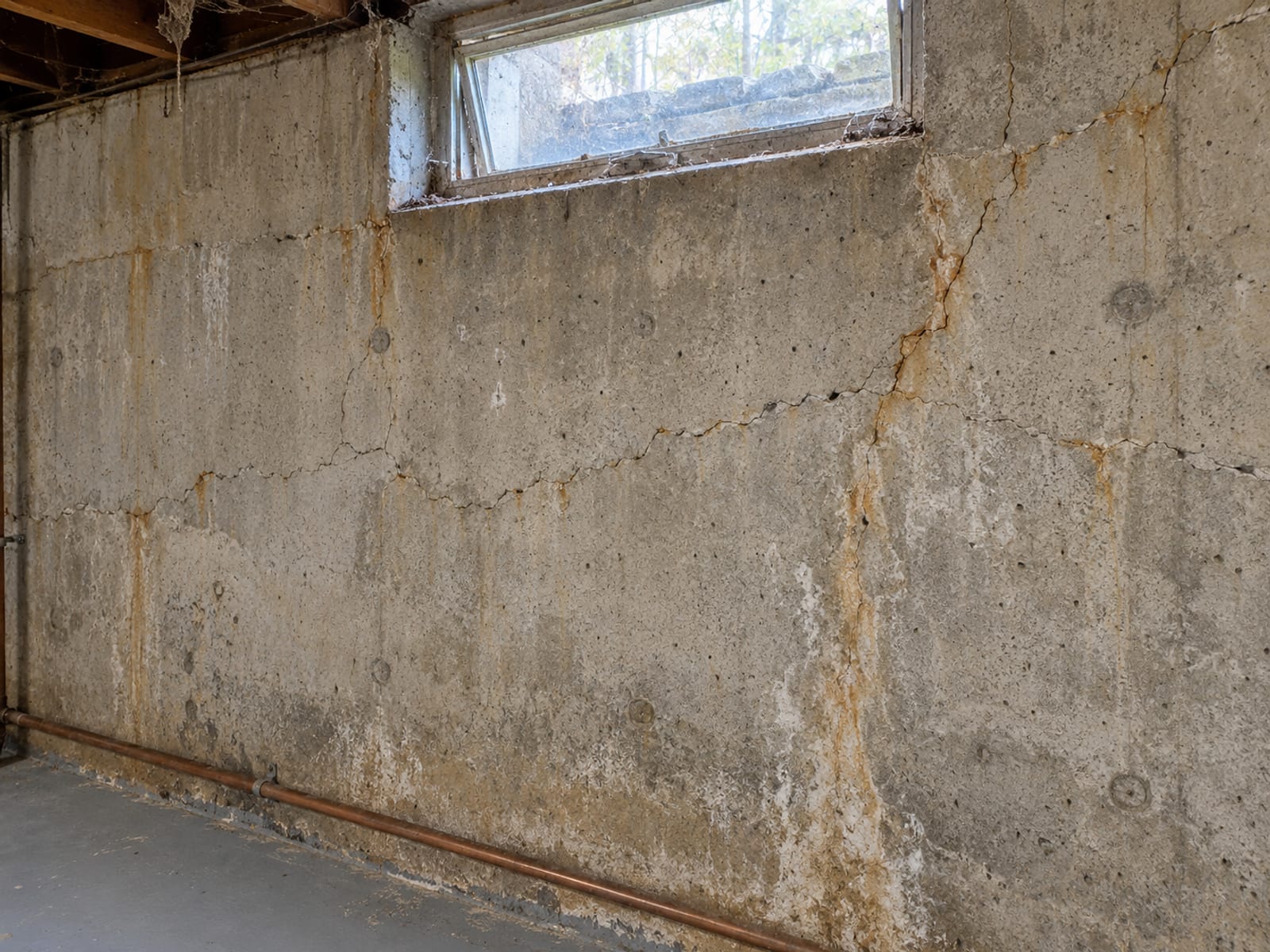
Deterioration can show up as map cracking, wall cracks, discoloration, exposed aggregate, rust-colored staining, widening cracks, bowing, displacement or a progressive loss of structural strength. The presence of pyrrhotite alone does not decide whether a foundation has to be replaced. The Department of Housing separates a visual inspection by a professional engineer from core testing, and the engineering report is what an insurer, lender or buyer reads.
Hover or tap a row to highlight it.
| Item | Figure | Source |
|---|---|---|
| Homes that may face potential foundation failure | Upwards of 35,000 near Stafford Springs | Connecticut Department of Housing (opens in a new tab) |
| Concrete period identified | Homes built with J.J. Mottes concrete between 1983 and 2015 | Connecticut Department of Housing (opens in a new tab) |
| Visual inspection reimbursement | 100% up to $400 | Connecticut Department of Housing (opens in a new tab) |
| Core testing reimbursement | 50% up to $2,000 | Connecticut Department of Housing (opens in a new tab) |
| CFSIC Type 1 maximum, residential building | $205,000 for first-time proposals dated and submitted on or after January 20, 2026 | CFSIC FAQ (opens in a new tab) |
| CFSIC maximum, condominium unit | $82,000 per unit under the same guideline | CFSIC FAQ (opens in a new tab) |
| Healthy Homes surcharge | $12 per applicable homeowners policy during the statutory period | Connecticut General Assembly bill summary (opens in a new tab) |
What CFSIC is, and what it pays
The Connecticut Foundation Solutions Indemnity Company (CFSIC) was created as a captive insurance company by Public Act 17-2 of the June 2017 special session to help with residential foundations deteriorating because of pyrrhotite (Connecticut Office of Legislative Research (opens in a new tab)). It is a nonprofit captive that facilitates financial assistance; it does not sell ordinary insurance policies. Funding has included state bonds and the Healthy Homes surcharge, a $12 charge on the named insured under homeowners policies during the statutory period, with 85 percent of surcharge deposits going to the Crumbling Foundations Assistance Fund (bill summary (opens in a new tab)). Later legislation extended the surcharge sunset to December 31, 2041 and removed CFSIC's original June 30, 2022 end date (2021 fiscal analysis (opens in a new tab)).
CFSIC pays assistance under its current claims guidelines. For first-time proposals dated and submitted on or after January 20, 2026, a Type 1 payment, including the applicable linear-foot or square-foot cost factor, is capped at $205,000 for a residential building and $82,000 per condominium unit (CFSIC FAQ (opens in a new tab)). Those are program limits, not insurance amounts or promised payments.
The state's testing reimbursement program has narrower rules than the full CFSIC claim program. It requires a visual inspection by a Connecticut-licensed professional engineer, a home built on or after January 1, 1983 and before December 31, 2015 (or an addition built in those years), and a location in Connecticut within 20 miles of J.J. Mottes Concrete Company in Stafford Springs, and the Department of Housing describes it as available to homeowners (Connecticut Department of Housing (opens in a new tab)). For a two-to-four family house, a condominium building, a larger apartment property or an investor-owned building, confirm with CFSIC (opens in a new tab) whether the specific building, ownership, occupancy, construction year and claim type fit its current rules before counting on assistance.
Connecticut's crumbling foundation response
- 1983 to 2015Homes built with J.J. Mottes concrete in this period are identified as potentially affected.
- 2017Public Act 17-2, June special session, created CFSIC as a captive insurance company.
- 2018Public Act 18-160 imposed the $12 Healthy Homes surcharge on homeowners policies.
- 2019The Connecticut Insurance Department's crumbling foundation notice and its June 10 condominium update.
- January 20, 2026Current CFSIC caps of $205,000 per residential building and $82,000 per condominium unit apply to first-time proposals from this date.
How courts have read collapse and foundation claims
Connecticut decisions show why no single coverage answer fits every pyrrhotite claim. In Jemiola v. Hartford Casualty Insurance Co., Connecticut Supreme Court docket SC 19978 (Connecticut Judicial Branch (opens in a new tab)), the court considered pyrrhotite-related cracking under a policy that defined collapse as an abrupt falling down or caving in, with further limits. It held that this wording did not reach a standing home that could still be safely lived in.
In Karas v. Liberty Insurance Corp., docket SC 20149 (Connecticut Judicial Branch (opens in a new tab)), the Connecticut Supreme Court read a different policy's collapse wording and held that it did not unmistakably limit coverage to a building reduced to rubble, applying a substantial impairment standard. In the Connecticut Appellate Court's official opinion at 209 Conn. App. 75 (opens in a new tab), the court addressed pyrrhotite cracking, gradual deterioration, a cracking exclusion and a definition requiring a sudden caving in, and applied the policy wording and facts before it.
Hover or tap a row to highlight it.
| Case | Court | Policy question | Result |
|---|---|---|---|
| Jemiola v. Hartford Casualty Insurance Co., SC 19978 (opens in a new tab) | Connecticut Supreme Court | Collapse defined as an abrupt falling down or caving in | Wording did not reach a standing home that could be safely lived in |
| Karas v. Liberty Insurance Corp., SC 20149 (opens in a new tab) | Connecticut Supreme Court | Collapse wording in a different policy | Wording did not unmistakably require rubble; substantial impairment standard applied |
| 209 Conn. App. 75 (opens in a new tab) | Connecticut Appellate Court | Cracking exclusion, gradual deterioration and a sudden caving in definition | Court applied the policy wording and facts before it |
The policy wording, its exclusions, the definition of collapse, the date of loss and the facts decide a foundation claim. On a multifamily property, ask the agency whether the policy carries a foundation, cracking, deterioration, faulty material or collapse exclusion, and which definition of collapse it uses.
What the Insurance Department said about nonrenewal
The Connecticut Insurance Department's 2019 notice tells insurers writing homeowners and condominium coverage that they may not cancel or refuse to renew an individual's homeowners policy because of a crumbling foundation issue (Connecticut Insurance Department notice (opens in a new tab)). A June 10, 2019 update applies the notice to condominium association master policies covering residential unit buildings (notice update (opens in a new tab)).
The notice speaks to homeowners policies and condominium master policies. It does not create coverage for foundation deterioration, and a commercial apartment building policy is a different form, so a REIT owner asks the agency which renewal and cancellation rules apply to its actual policy. Homeowners readers can find the personal-lines side in our guide to Connecticut homeowners insurance.
What a seller must disclose about the foundation
Connecticut's residential condition report, required in covered residential transfers under Conn. Gen. Stat. § 20-327c (opens in a new tab), asks about knowledge of pyrrhotite in any concrete foundation, damage or deterioration in a concrete foundation including damage caused by pyrrhotite, and foundation repairs or remediation. A separate foundation condition report from the Department of Consumer Protection applies to residential property in municipalities identified as affected or potentially affected when the property was acquired by a political subdivision, through strict foreclosure, foreclosure by sale or a deed in lieu of foreclosure (Department of Consumer Protection form (opens in a new tab)). The seller provides it before the buyer signs a binder, purchase contract, option or lease with a purchase option, and failing to furnish it requires a $500 credit at closing.
The report is not a substitute for an inspection or testing, and the form urges buyers to have the foundation inspected by an expert. Which report applies depends on the transaction, the property type, the municipality and the statutory category, so a REIT buying a building in the affected area orders its own engineering review rather than relying on the seller's answers.
Older-building rules: lead paint, detectors and landlord duties
Housing built before 1978 may contain lead paint, and Connecticut landlords must keep painted surfaces intact and may not dry scrape, sand or, where the rules prohibit it, power-wash painted surfaces on pre-1978 buildings (Connecticut Department of Public Health (opens in a new tab)). When a child under six has an elevated venous blood lead level, the local health department investigates, including a comprehensive lead inspection, and issues a lead abatement order if it finds hazards. The landlord must post signs at the entry within two days of receiving the order and submit a written abatement plan; abatement begins only after the health department approves it, and the unit gets a visual assessment and clearance dust-wipe sampling before people move back in. Federal rules add a pre-lease lead disclosure and pamphlet for pre-1978 housing and require EPA-certified firms for covered renovation work (Department of Public Health disclosure guidance (opens in a new tab)).
Detector rules depend on building size. At closing on a one- or two-family residential building or a unit in a common interest community, the transferor signs an affidavit that smoke and carbon monoxide detection equipment complies with the statute, or that the building has no carbon monoxide risk because it has no fuel-burning appliance, fireplace or attached garage (Conn. Gen. Stat. § 29-453 (opens in a new tab)). Smoke equipment goes in or near each bedroom, and for buildings constructed before January 1, 1990 the transferor may state that the interconnection requirement does not apply. Larger apartment buildings fall under the State Fire Prevention Code, the State Building Code and occupancy rules, which can require more.
Landlord duties feed into liability and claim facts. A landlord must comply with building and housing codes that materially affect health and safety, make repairs, keep common areas clean and safe, keep supplied appliances in safe working order and supply heat and hot water where required (Conn. Gen. Stat. § 47a-7 (opens in a new tab)). A rental agreement may not let a landlord collect rent for a period of noncompliance (Conn. Gen. Stat. § 47a-4a (opens in a new tab)), and tenants have their own duties under Conn. Gen. Stat. § 47a-11 (opens in a new tab). These duties shape premises liability, habitability disputes, inspections and documentation, though they do not decide coverage by themselves.
Questions to ask an agency
These questions work for an acquisition, a renewal or a building with known foundation history:
- How will the property be classified based on unit count, ownership, occupancy and use, and which policy form follows?
- Which form covers the building, premises liability, rental income, equipment and business interruption?
- What foundation reports, core tests, visual inspections, claim files or repair records does the insurer need, and how should known cracking or pyrrhotite be disclosed?
- Does the policy contain a foundation, cracking, deterioration, faulty material or collapse exclusion, and what definition of collapse applies?
- How are older roofs, boilers, electrical systems, plumbing, elevators and heating evaluated?
- What lead, smoke, carbon monoxide, fire code and inspection records should be provided?
- Which lender insurance provisions must the policy match? Our guide to Connecticut REIT lender insurance requirements covers that side.
- Are flood, sewer backup, equipment breakdown, environmental, cyber or umbrella coverage handled separately?
- How are replacement cost, actual cash value, ordinance or law, vacancy and loss of rent written?
- What changes must be reported after an acquisition, a renovation, a vacancy or a foundation test?
- If a policy is nonrenewed or declined, what written reason and other placement options apply?
Check each agency and producer on the Connecticut insurance license lookup (opens in a new tab) and confirm the license is active and covers the line of insurance before relying on the placement.

Check what you know about Connecticut multifamily insurance
Frequently asked questions
Short answers to common questions about Connecticut multifamily coverage.
Is Connecticut multifamily insurance homeowners or commercial insurance?
It depends on the property, ownership, occupancy, unit count and the insurer's underwriting classification. Ask the agency which policy form applies and why, and compare it with the lender's requirements.
Does insurance automatically cover pyrrhotite damage in Connecticut?
No single answer applies. Connecticut Supreme Court and Appellate Court decisions turned on each policy's collapse definition, exclusions and facts, so the actual policy wording is what to read.
Can a buyer rely on a seller's foundation disclosure?
The Connecticut form states that it is not a substitute for inspections, testing or other ways of determining foundation condition. A buyer orders its own engineering review, and the $500 closing credit applies only when a required foundation report is not furnished.
Does the crumbling foundation nonrenewal notice protect an apartment building policy?
The Connecticut Insurance Department's 2019 notice addresses individual homeowners policies and condominium association master policies covering residential unit buildings. For a commercial apartment policy, ask the agency which renewal and cancellation rules apply.
Your next step
Build the file first: ownership, units, construction year, foundation reports, systems records, lead and detector records, leases and the lender's insurance clauses. The wider Connecticut program, from surplus lines to flood and lender rules, is in our guide to Connecticut REIT insurance, and flood questions for a single building are in Connecticut flood insurance. Riskado lists insurance agencies across the state in our Connecticut agency directory; take the questions above to the ones you contact.
Key terms
Tap a term to see what it means.
Pyrrhotite. An iron sulfide mineral that can oxidize in concrete aggregate, expand and crack foundations.
CFSIC. The Connecticut Foundation Solutions Indemnity Company, a captive insurer created to distribute crumbling foundation assistance.
Collapse provision. Policy wording that defines when structural failure counts as a covered collapse; definitions differ between policies.
Core test. A laboratory test of a concrete sample taken from a foundation, separate from a visual inspection.
Residential condition report. Connecticut's seller disclosure form for covered residential transfers, including pyrrhotite questions.
Lead abatement order. A local health department order to correct lead hazards after an elevated blood lead finding.
Loss of rent. Coverage for rental income lost while a covered loss is repaired, written differently by each policy.