How Much Car Insurance Do I Need: State Minimums, Real-World Limits, and What Lenders Add
Riskado
How much car insurance you need depends first on your state's legal minimums, then on whether a lender or leasing company requires coverage for your own vehicle, and finally on what you want your policy to protect. Liability limits pay for covered injury or property damage you cause to others, up to the stated limits. Collision and comprehensive coverage address specified damage to your own car. Uninsured and underinsured motorist coverage addresses injuries caused by a driver with no insurance or too little. Each state sets its own minimum limits in its law, and its insurance department (opens in a new tab) publishes them; a common form is 25/50/25, meaning $25,000 per person and $50,000 per accident for bodily injury and $25,000 per accident for property damage. A lender or lease contract can require more than state law does.
Key takeaways
- Legal minimumYour state sets the floor in its own law, and the numbers differ from state to state.
- Uninsured and underinsured motorist coverageSome states include it in the required minimums, so check your state's rule.
- Lenders and lessorsA loan or lease contract can require more than state law does, including collision and comprehensive.
- Your own situationWhat you own, what you earn, who rides with you and what the car is worth decide what you want your policy to protect.
What determines how much car insurance you need?
Three layers stack on top of each other. The legal minimum is the floor, and it is the only layer the state sets. A lender or lessor adds requirements if you financed or leased the car. Your own situation adds the rest: what you own, what you earn, who rides with you, who else drives, and what the car is worth.
The first layer is a legal floor and nothing more. Minimum limits may not provide sufficient financial protection (opens in a new tab), as state insurance regulators point out to consumers. What protection you want above the floor is a conversation to have with a licensed agent about your own facts, and no single number fits every driver.
What do limits such as 25/50/25 mean?
A split limit is three numbers that cap what the policy pays. In 25/50/25, the first number is the most the policy pays for bodily injury to one person in one accident, which is $25,000. The second is the most it pays for bodily injury to all injured people in one accident, which is $50,000. The third is the most it pays for property damage in one accident, which is $25,000 (Ally (opens in a new tab)).
What 25/50/25 means
- First number, 25The most the policy pays for bodily injury to one person in one accident, which is $25,000.
- Second number, 50The most it pays for bodily injury to all injured people in one accident, which is $50,000.
- Third number, 25The most it pays for property damage in one accident, which is $25,000.
Bodily injury liability addresses covered claims by people injured or killed when you are legally responsible. Property damage liability addresses covered damage to another person's vehicle or property. Claims can include medical expenses, lost wages, and pain and suffering on the injury side, and vehicles, walls, fences, and equipment on the property side, as state insurance department guidance (opens in a new tab) describes them. Some policies use one combined single limit instead of split limits, so ask which form your quote uses. The exact policy wording, exclusions, and conditions control.

How do state minimum limits work?
Each state writes its minimum car insurance limits into its own law, and its insurance department or DMV (opens in a new tab) publishes the current figures. The minimum is usually a split limit for bodily injury and property damage liability. A state may also allow a single combined limit instead, add uninsured and underinsured motorist coverage, or add personal injury protection. Limits change over time, so check the current page for your state before you rely on any figure.
For example, Connecticut requires 25/50/25 or a $50,000 single limit, plus at least $25,000/$50,000 in uninsured and underinsured motorist coverage (Conn. Gen. Stat. § 14-112 (opens in a new tab); § 38a-336 (opens in a new tab)). The full rules are in our guide to Connecticut car insurance requirements.
How do minimum limits differ from state to state?
State minimums differ, and they change over time. Three examples show the spread: the Connecticut example above, California and Massachusetts.
California's DMV requires private passenger vehicles to carry $30,000 for injury or death to one person, $60,000 for more than one person, and $15,000 for property damage (opens in a new tab), under California Insurance Code § 11580.1b.
Massachusetts raised its minimums effective July 1, 2025. The minimums are $25,000 per person and $50,000 per accident for bodily injury to others, the same $25,000/$50,000 for bodily injury caused by an uninsured auto, $30,000 per accident for damage to someone else's property, and $8,000 in personal injury protection (opens in a new tab), according to the Division of Insurance. The state's Filing Guidance Notice 2025-A (opens in a new tab) gives the effective date.
Hover or tap a row to highlight it.
| State | Minimums | Source |
|---|---|---|
| Connecticut | $25,000 per person and $50,000 per accident for bodily injury; $25,000 per accident for property damage; at least $25,000/$50,000 in uninsured and underinsured motorist coverage | Connecticut Insurance Department (opens in a new tab) |
| California | $30,000 for injury or death to one person, $60,000 for more than one person, and $15,000 for property damage | California DMV (opens in a new tab) |
| Massachusetts | $25,000 per person and $50,000 per accident for bodily injury to others; $25,000/$50,000 for bodily injury caused by an uninsured auto; $30,000 per accident for property damage; $8,000 in personal injury protection (effective July 1, 2025) | Massachusetts Division of Insurance (opens in a new tab) |
If you drive in or move to another state, ask your agent how that state's requirements apply to your policy.
What coverage protects other people?
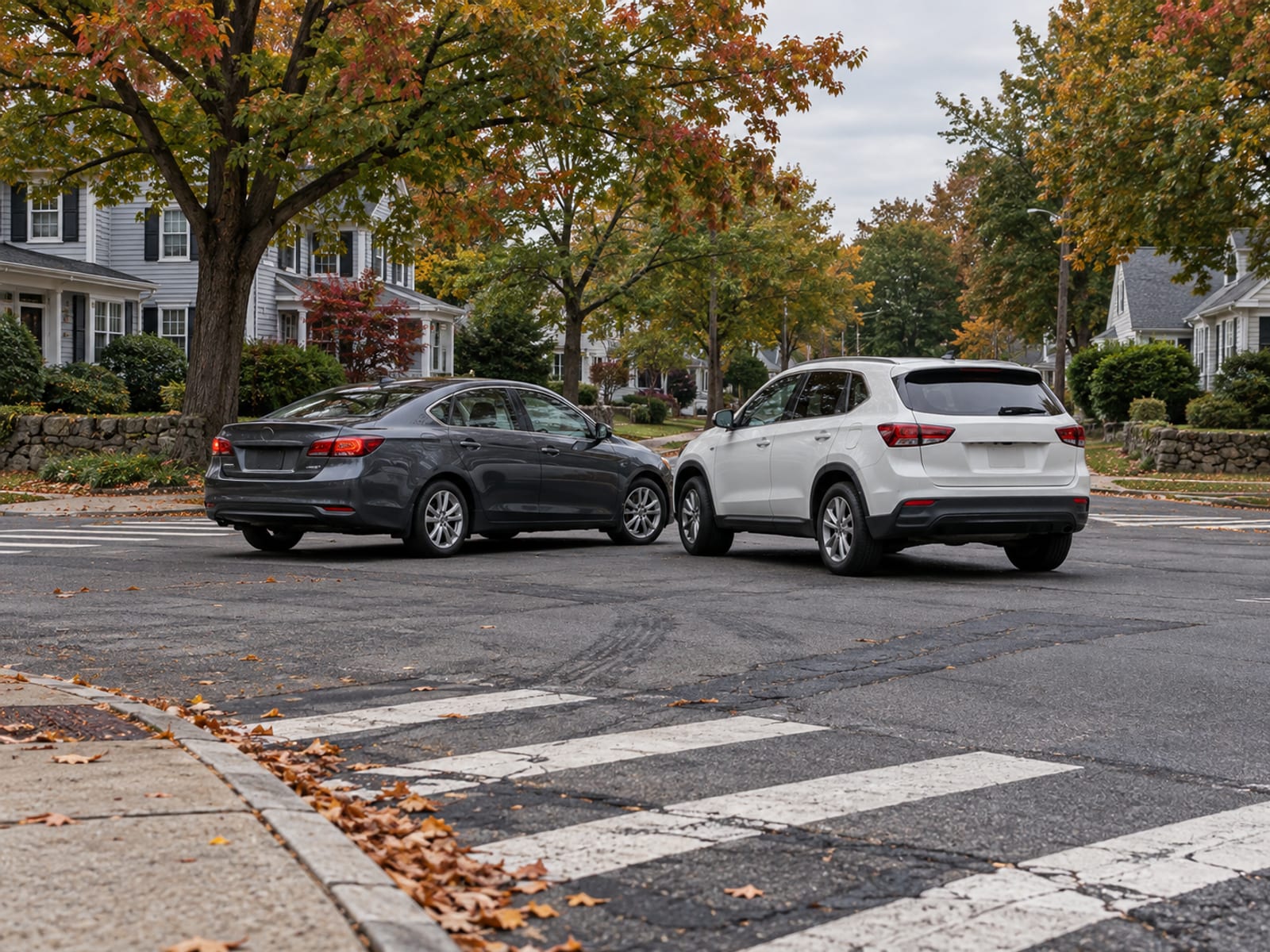
Liability coverage does. Bodily injury liability and property damage liability pay for covered damage you cause to others, up to your policy's limits. Neither one pays to repair your own car, which is a common point of confusion.
When a claim is larger than your limit, the policy pays only according to its terms and limits. A judgment or settlement above the available limit may leave the legally responsible driver personally responsible for the difference.
For a sense of claim size, the Insurance Information Institute's 2022 national averages (opens in a new tab) for paid auto liability claims were $24,211 for bodily injury and $5,313 for property damage. In 2022, 0.7 percent of insured people had a bodily injury liability claim and 2.4 percent had a property damage claim. Those are averages across the country, not predictions for one accident. A single serious injury, several injured people, an expensive vehicle, or a damaged building can cost more than an average claim.
What coverage protects your own vehicle?
Collision and comprehensive do. Collision covers physical damage to your vehicle from a collision, subject to the policy and deductible. Comprehensive covers specified non-collision causes such as theft, fire, severe weather, vandalism, floods, and falling objects, subject to the policy and deductible (state insurance department definitions (opens in a new tab)).
Whether state law requires either coverage depends on your state; a lender or leasing company may require both even where the law does not. The 2022 national average paid claim was $5,992 for collision and $2,738 for comprehensive (opens in a new tab), according to the Insurance Information Institute. The average incurred loss per collision claim rose from $5,185 in 2020 to more than $6,150 in 2021, according to the NAIC (opens in a new tab).
Hover or tap a row to highlight it.
| Measure | Figure | Source |
|---|---|---|
| Average paid bodily injury liability claim, 2022 | $24,211 | Insurance Information Institute (opens in a new tab) |
| Average paid property damage liability claim, 2022 | $5,313 | Insurance Information Institute (opens in a new tab) |
| Average paid collision claim, 2022 | $5,992 | Insurance Information Institute (opens in a new tab) |
| Average paid comprehensive claim, 2022 | $2,738 | Insurance Information Institute (opens in a new tab) |
| Average incurred loss per collision claim, 2021 | More than $6,150 | NAIC (opens in a new tab) |
Your deductible is the amount you pay first on a covered claim. A deductible should be an amount you can pay right away, according to Ally (opens in a new tab). Vehicle value matters here too, so ask the agent how your car's value compares with the premium for physical-damage coverage on it, whether the loan is paid off or not.
What does a lender or leasing company require?
State minimum liability does not necessarily satisfy a lender or lessor. Lenders and lessors commonly require:
- Collision coverage.
- Comprehensive coverage.
- Continuous coverage for the life of the loan or lease.
- Proof of insurance.
- The lender or lessor listed as lienholder or loss payee.
- A deductible within the contract's limit.
Vehicles financed or leased through Ally (opens in a new tab) should carry full coverage with Ally listed as lienholder or lessor, and lenders may require collision and comprehensive, according to Chase (opens in a new tab). In some cases a lender buys insurance on its own and charges the borrower if required coverage lapses.
Gap coverage is a separate product. GAPCoverage (opens in a new tab) protects against the difference between the insurance payoff and the finance balance, subject to exclusions. A borrower remains responsible for deductibles and balances the primary insurer does not cover, including amounts above policy limits, according to Ford Credit (opens in a new tab). The permitted deductible varies by contract, so confirm it in your loan or lease agreement.
What does uninsured and underinsured motorist coverage do?
It pays for injuries caused by an uninsured driver, a hit-and-run driver, or a driver whose liability insurance is not enough, according to state insurance department definitions (opens in a new tab). Whether a state requires it, the minimum it sets, and whether you can lower or reject it in writing all come from that state's law, so ask your agent what your state allows.
Some states tie it to your liability limits. For example, Connecticut requires uninsured and underinsured motorist limits equal to the liability limits you buy unless a named insured requests a lower amount in writing, and never below the state minimum (Conn. Gen. Stat. § 38a-336 (opens in a new tab)). Our guide to uninsured motorist coverage explains what it pays and when it can be declined. Ask your agent whether your uninsured and underinsured limit matches your bodily injury liability limit.
What factors should be discussed with an agent?
These facts shape the conversation, and none of them produces a single correct limit on its own:
- Assets and income. Umbrella coverage should be considered at a level high enough to help protect assets above your other liability coverage, according to the Massachusetts Division of Insurance (opens in a new tab). An umbrella policy sits above the limits of underlying auto or homeowners insurance, and an umbrella insurer may require certain underlying limits.
- Passengers and household drivers. Frequent passengers and other drivers in your household are part of the discussion (Ally (opens in a new tab)).
- Vehicle value and financing. Both affect collision, comprehensive, and lender requirements.
- Driving habits. Commute distance, mileage, and where the car is parked all count, per Ally.
- Business use. Personal auto policies generally exclude business activities such as pizza delivery (opens in a new tab). If you drive for delivery or rideshare work, disclose it and ask whether separate or amended coverage is required.
- Deductible affordability. The deductible is what you pay before the policy does.
"Full coverage" is a common phrase, not a legal package with one definition. Ask for the individual coverage names and limits on your quote instead.
What happens if coverage lapses or damages exceed limits?
If damages exceed your limits, the responsibility for the remainder may fall on you personally, as covered above. An umbrella policy is one way some drivers address that gap, subject to its own terms and exclusions.
If coverage lapses on a financed or leased vehicle, the lender may buy insurance under the contract and bill you for it. State lapse consequences, such as registration penalties, differ by jurisdiction, so confirm them with your state's DMV or insurance department.
What should you ask an insurance agent?
Bring your current policy, your loan or lease agreement, and a list of drivers and vehicles. Then ask:
- What are my state's current minimum limits?
- Which numbers on this quote are per person, per accident, and property damage?
- Are the limits split, or a combined single limit?
- What does each liability limit pay for?
- What uninsured and underinsured motorist coverage is required or available, and does it match my liability limit?
- Does my lender or lease require collision or comprehensive, and what deductible does it allow?
- Is my lender or lessor listed correctly?
- If the car is totaled and the loan balance is more than its actual cash value, does gap coverage apply, and what does it exclude?
- Is business, delivery, or rideshare use covered?
- Are all licensed household drivers and regular operators listed?
- What happens if the policy lapses?
- Would an umbrella policy require different underlying auto limits?
- Which exclusions or endorsements change the quoted coverage?
- How often should I review the policy?
Check what you know about car insurance limits
Frequently asked questions
Is 50/100/50 enough?
The answer depends on what you own, what you earn, and who is in the car. A quote with 50/100/50 limits pays up to $50,000 per person and $100,000 per accident for injury, and $50,000 for property damage. Ask your agent how those limits compare with your assets and whether an umbrella policy would sit above them.
Do I need collision on a paid-off car?
With no loan or lease, no lender requirement applies, so check whether your state's law requires it. After that, the choice comes down to your car's value and whether you could afford the repair or replacement yourself, which are good questions to put to your agent.
Does owning a home change how much car insurance I need?
Assets are one of the factors to discuss. Umbrella coverage can be set at a level high enough to help protect assets above your auto and home liability limits, according to the Massachusetts Division of Insurance (opens in a new tab).
What if my claim costs more than my limit?
The policy pays only up to its limits. The legally responsible driver may be personally responsible for the rest.
Is $1 million in liability enough?
Ask the agent whether an umbrella policy would add limits above your auto liability, and which underlying auto and home limits the umbrella insurer requires.
Your next step
Take the questions above to a licensed agency and ask for the answers on your actual quote. You can find one in the Riskado insurance agency directory. Check the agent's license first through your state's insurance department (opens in a new tab).
Terms used in this guide
Tap a term to see what it means.
Split limit. Three numbers that cap what a liability policy pays: bodily injury per person, bodily injury per accident and property damage per accident.
Bodily injury liability. Coverage for covered claims by people injured or killed when you are legally responsible.
Property damage liability. Coverage for covered damage to another person's vehicle or property.
Uninsured and underinsured motorist coverage. Coverage for injuries caused by a driver with no insurance, a hit-and-run driver or a driver with too little liability insurance.
Collision. Coverage for physical damage to your own vehicle from a collision, subject to the policy and deductible.
Comprehensive. Coverage for specified non-collision causes such as theft, fire, severe weather, vandalism, floods and falling objects.
Deductible. The amount you pay first on a covered claim.
Lienholder or loss payee. The lender or lessor listed on your policy because it has an interest in the vehicle.
Gap coverage. A separate product that protects against the difference between the insurance payoff and the finance balance, subject to exclusions.
Umbrella policy. Coverage that sits above the limits of underlying auto or homeowners insurance.