North Carolina Small Business Insurance: Workers' Compensation at Three Employees, Commercial Auto and What to Ask Your Agent
Riskado
A North Carolina business generally must carry workers' compensation once it regularly employs three or more employees, or it must qualify as self-insured, according to the North Carolina Industrial Commission (opens in a new tab). Corporate executive officers count toward those three, although an eligible officer may exclude himself or herself from coverage. Work involving radiation follows a one-employee rule, and certain trucking owner-operators have special rules. Business vehicles must carry North Carolina's required liability coverage, and the ordinary minimums rose for policies issued or renewed after July 1, 2025, according to NCDMV (opens in a new tab). Certain commercial carriers need far higher limits. General liability, professional liability, property, business interruption and a business owner's policy cover different risks, and a contract, landlord, lender or licensing law can require them.
Key takeaways
- Workers' compensationRequired once a business regularly employs three or more employees, unless it qualifies as self-insured.
- Corporate officersExecutive officers count toward the three, although an eligible officer may exclude himself or herself from coverage.
- Radiation workOne employee doing radiation-related work is enough to require coverage.
- Business vehiclesOrdinary liability minimums rose for policies issued or renewed after July 1, 2025, and certain commercial carriers need far higher limits.
- Other coverageGeneral liability, professional liability, property, business interruption and a BOP cover different risks and can be required by a contract, landlord, lender or licensing law.
Does hiring a third employee mean you need workers' compensation?
For most North Carolina businesses, yes. The general threshold is three or more employees who are regularly employed, and the employer then needs a workers' compensation policy or approval as a self-insurer, according to the Industrial Commission (opens in a new tab). G.S. 97-13 (opens in a new tab) exempts employers with fewer than three employees in the same business in North Carolina, but that exemption doesn't apply to an employer with one or more employees doing work that involves radiation.
How you count matters as much as the number. A corporation's executive officers count toward the threshold, so a corporation with two executive officers and one employee generally reaches three. Eligible officers can elect to exclude themselves from coverage under the policy, but they still count when you decide whether coverage is required. Volunteer executive officers of certain nonprofit corporations count as well, even when they aren't paid, according to the Industrial Commission (opens in a new tab).
If your business is close to the line, write down every person who works for it, their role and how often they work. Then ask your agent, or the Industrial Commission, how each one is treated before you hire the next person. Our article on workers' comp for one employee covers the general question across states.
Who counts as an employee, and who may be exempt?
Chapter 97 of the General Statutes (opens in a new tab) defines who is an employee in G.S. 97-2 (opens in a new tab) and lists the exceptions in G.S. 97-13 (opens in a new tab). The exceptions include casual employees, certain farm laborers, federal government employees, domestic servants and employers with fewer than three employees, subject to the radiation exception.
Part-time, seasonal and family workers don't fit a single rule. Whether they count depends on the actual working relationship and on which exemption, if any, applies. The same is true of subcontractors and people you call independent contractors. A label on a contract doesn't settle the question; the facts of the work do.
Owners need their own look. Sole proprietors, partners and LLC members shouldn't be counted in or left out without checking the ownership structure, any election made on the policy and the statute. Corporate officers are clearer: they count toward the threshold, and an eligible officer may elect out of coverage.
Trucking is a special case. Certain trucking owner-operators are covered by special workers' compensation rules even when they're treated as independent contractors, and a motor carrier may have to provide coverage unless the owner-operator meets the conditions in G.S. 97-19.1 (opens in a new tab), according to the Industrial Commission. Construction and transportation businesses should confirm worker classification, subcontractor status, licensing and contract terms separately for each job.
What happens if a required employer has no workers' compensation?
An employer subject to Chapter 97 must keep workers' compensation insurance in force or qualify as self-insured under G.S. 97-93 (opens in a new tab). The Industrial Commission's Compliance Division (opens in a new tab) investigates employers who are subject to the Act but have neither insurance nor self-insured status, and it can assess an administrative penalty for the period of noncompliance.
Civil penalties are authorized under G.S. 97-94 (opens in a new tab), including potential assessments based on compensation due, according to the Industrial Commission. Separately, an employer that fails to insure or qualify as a self-insurer can be held liable in a civil action for the compensation awarded to an injured worker, under G.S. 97-95 (opens in a new tab).
Penalty amounts depend on the statute and the facts of each case. If you think your business has a gap, contact the Compliance Division (opens in a new tab) about your situation and the current consequences, and start the conversation with an agent about coverage the same day.
How do you get workers' compensation in North Carolina?
Most employers buy a policy from a private insurance company through an agent. A covered business must either carry insurance or qualify as self-insured, according to the Industrial Commission (opens in a new tab). Self-insurance requires qualifying under North Carolina's requirements, so confirm eligibility and the application steps with the Industrial Commission and the North Carolina Department of Insurance.
If regular-market insurers turn your business down, the North Carolina Workers Compensation Insurance Plan is the next stop. The North Carolina Rate Bureau (NCRB) administers it, and it provides for the fair assignment of employers that are in good faith entitled to coverage but can't get it in the regular market, according to the NCRB (opens in a new tab) and its Rule 4 assigned-risk plan rules (opens in a new tab). The plan still involves an application and an eligibility review, so ask your agent to submit it if the regular market declines you.
What auto insurance do business vehicles need?
Every registered vehicle in North Carolina must carry liability insurance that meets the state minimums, and those minimums changed in 2025. For policies issued or renewed after July 1, 2025, NCDMV (opens in a new tab) lists these limits:
Hover or tap a row to highlight it.
| Coverage | Policies issued or renewed before July 1, 2025 | Policies issued or renewed after July 1, 2025 |
|---|---|---|
| Bodily injury, one person | $30,000 | $50,000 |
| Bodily injury, two or more people | $60,000 | $100,000 |
| Property damage | $25,000 | $50,000 |
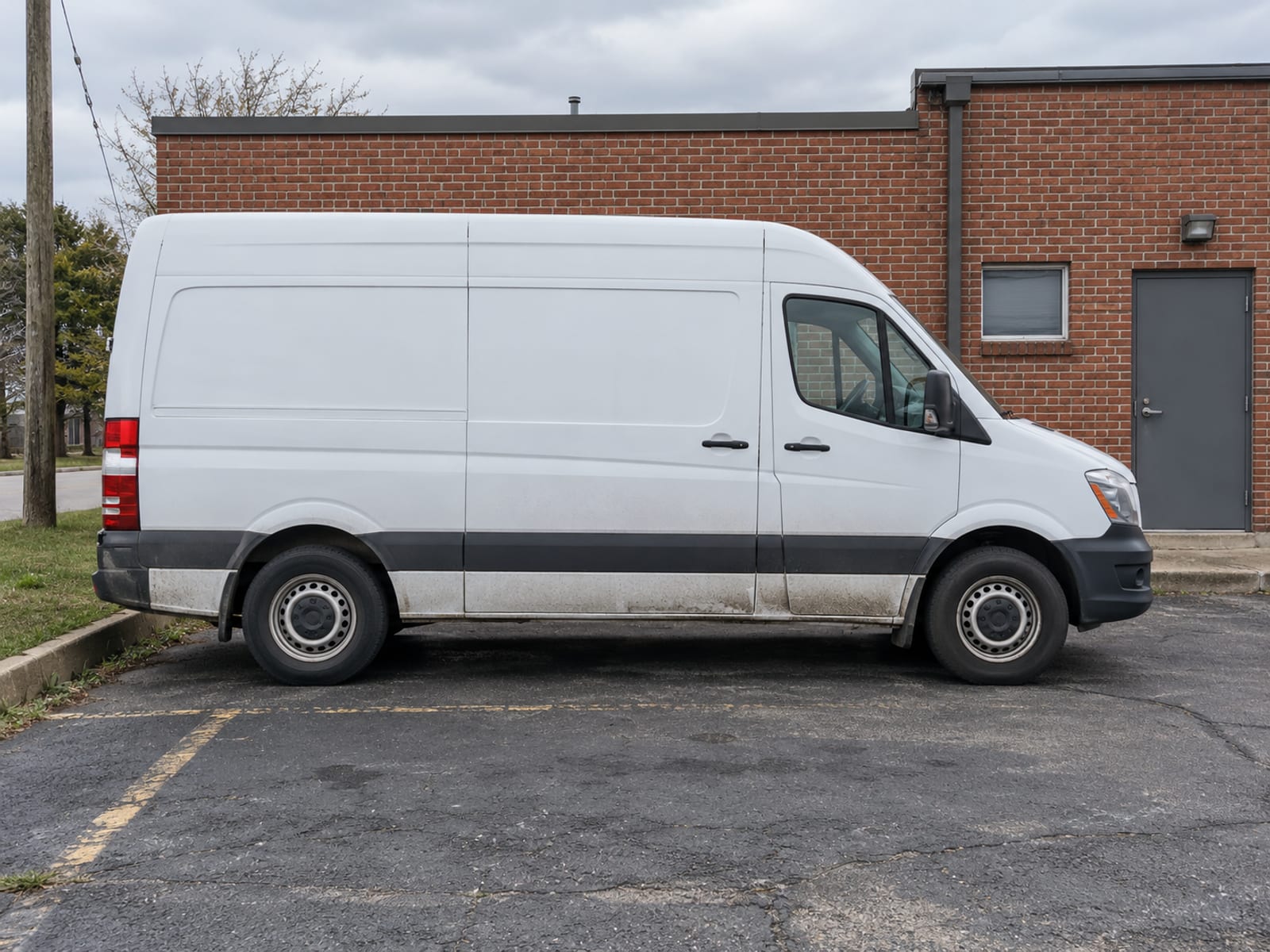
Uninsured and underinsured motorist coverage is also required, according to NCDMV (opens in a new tab). The minimums are a legal floor. Whether a van, pickup or delivery car needs a commercial auto policy depends on how it's used, who owns it and who drives it. Business-related driving may be excluded from a personal auto policy or require commercial coverage, according to the NAIC (opens in a new tab), so tell your agent about every vehicle used for work, including employee-owned and rented ones. Our article on North Carolina car insurance requirements covers the personal auto rules in more detail.
When do commercial carriers need higher limits?
North Carolina requires any commercial motor vehicle owner to keep financial responsibility equal to the federal requirement for for-hire carriers hauling non-hazardous property in interstate or foreign commerce, which is $750,000, according to the NCDOT commercial trucking page (opens in a new tab). Hazardous materials and passenger operations carry higher amounts.
Hover or tap a row to highlight it.
| Operation | Minimum listed by NCDOT |
|---|---|
| For-hire carrier, non-hazardous property, interstate or foreign commerce | $750,000 |
| Certain oil or hazardous-material operations | $1 million |
| Specified hazardous materials | $5 million |
| Specified explosive or poison-gas operations | $5 million |
| Passenger vehicles seating 16 or more | $5 million |
| Passenger vehicles seating 15 or fewer | $1.5 million |
The amount that applies to you depends on the vehicle type, cargo, seating, registration and operating authority. Regulated motor carriers that hold a certificate or broker license also have security, bond or insurance requirements under G.S. 62-268 (opens in a new tab), which states minimums of $50,000 for one person, $100,000 for two or more people and $50,000 for property damage, and allows higher amounts.
How do general liability, professional liability and a BOP differ?
General liability addresses claims from other people for bodily injury, property damage and advertising injury, along with medical expenses, defense costs, settlements and judgments, subject to the policy's terms and exclusions, according to the SBA (opens in a new tab) and the NAIC (opens in a new tab). A customer who slips in your shop is the classic general liability claim.
Professional liability is different. It addresses claims that your professional work had errors or omissions, was negligent, or fell short of professional standards. An accountant's missed filing or a designer's flawed plan falls here, not under general liability. Our article on general liability vs professional liability insurance goes through the split.
A business owner's policy, or BOP, typically bundles commercial property, business interruption and general liability into one policy. A BOP typically doesn't include commercial auto, workers' compensation, health or disability insurance, or professional liability, according to the NAIC (opens in a new tab). If you buy a BOP, those exposures still need their own policies.

When do contracts, landlords, lenders or licensing laws require insurance or bonds?
Many insurance requirements come from a contract, not from a statute. A landlord, client, lender or general contractor can require general liability, property, commercial auto, workers' compensation, professional liability, additional insured status, specific limits or a bond. The exact contract controls, so get those requirements in writing before you sign.
Some activities have requirements set by law:
- Public construction: G.S. 44A-26 (opens in a new tab) requires performance and payment bonds on covered public construction contracts once the statutory project and contract thresholds are met, generally at 100% of the construction contract amount.
- Professional housemovers: G.S. 20-359.1 (opens in a new tab) requires specified motor vehicle insurance, comprehensive general liability insurance, workers' compensation for employees, and either a $25,000 property-damage bond or $50,000 in cargo insurance.
Other licensed activities may have their own requirements, so check the statute or the licensing agency for your exact work. Our article on how to get a surety bond explains how bonds are issued.
What does a certificate of insurance prove?
A certificate of insurance summarizes your coverage: the named insured, the policy period, the insurer, the coverage types and the limits. It isn't the policy, and it doesn't add coverage by itself. When a client asks for additional insured status, a waiver of subrogation, notice of cancellation or special wording, the insurer or agent has to handle that on the policy; the certificate only reports what the policy says.
North Carolina also uses certificates in specific places. NCDMV uses an electronic Certificate of Insurance, Form FS-1, to verify continuous vehicle liability coverage, and when an insurer submits an FS-1 showing continuous coverage, NCDMV can update its records and clear lapse penalties that apply, according to NCDMV (opens in a new tab). Professional housemovers must file insurance certificates for their motor vehicle, general liability and workers' compensation coverage under G.S. 20-359.1 (opens in a new tab).
Compare any certificate with the contract that asked for it and with the policy behind it.
What does small business insurance cost in North Carolina?
Premiums depend on the business: its type, payroll, sales, job classifications, vehicles, drivers, claims history, property, operations, limits, deductibles and policy forms.
The Rate Bureau's published figures give some reference points for workers' compensation. For the period from July 1, 2024 through June 30, 2025, the assigned-risk plan wrote 23,265 new or renewal policies with an average policy premium of $2,809, according to the NCRB's 2025 annual meeting minutes (opens in a new tab). That's an average for the assigned-risk book only, not a statewide small-business average and not a quote. For rates effective April 1, 2026, the approved average assigned-risk rate level fell 7.6% from the rates effective April 1, 2025, with changes varying by classification, according to the NCRB's assigned-risk rate filing circular (opens in a new tab).
Your own claims history can also move the price through an experience modification. The NCRB's calculation generally uses a 36-month experience period covering three policy years. For ratings effective April 1, 2026 and later, a business becomes eligible for experience rating at $15,000 in premium in the last one or two years, or $7,500 in average annual premium over a longer period, according to the NCRB's experience modification instructions (opens in a new tab).
Hover or tap a row to highlight it.
| Figure | Amount | Period or basis |
|---|---|---|
| Assigned-risk policies written | 23,265 new or renewal policies | July 1, 2024 through June 30, 2025 |
| Average assigned-risk policy premium | $2,809 | Assigned-risk book only, July 1, 2024 through June 30, 2025 |
| Average assigned-risk rate level change | 7.6% decrease | Rates effective April 1, 2026, compared with April 1, 2025 |
| Experience period | 36 months, generally three policy years | Experience modification calculation |
| Experience-rating eligibility | $15,000 premium in the last one or two years, or $7,500 average annual premium over a longer period | Ratings effective April 1, 2026 and later |
When you request quotes, ask which payroll, sales, classification and vehicle figures the insurer used, and what records it will review at audit.
What happens after a storm, and where does disaster aid fit?
Commercial property coverage addresses covered physical damage to business property, subject to the policy's covered causes of loss, exclusions, limits, deductibles, valuation and conditions. Business interruption coverage can pay lost income or continuing expenses after a covered physical loss, subject to waiting periods, the restoration period, limits and exclusions, according to the NAIC (opens in a new tab).
Flood is generally a separate coverage question from an ordinary commercial property policy. Before storm season, ask your agent how the policy treats flood, wind, named storms, utility service interruptions, equipment breakdown and business interruption.
SBA and FEMA disaster assistance doesn't replace insurance. The SBA (opens in a new tab) offers disaster planning help and financial assistance after disasters, but that aid depends on a declared disaster and the program's eligibility rules, while your insurance follows your policy.
How do you check an agent and file a complaint?
Ask the agent for a license number and confirm it with the North Carolina insurance license lookup (opens in a new tab) and the North Carolina Department of Insurance (NCDOI), which licenses and regulates insurance agents and insurers. An agency that sells, solicits or negotiates insurance in North Carolina generally needs a business-entity license with a designated responsible licensed producer under G.S. 58-33-31(b) (opens in a new tab), according to NCDOI (opens in a new tab). Confirm that the insurer is authorized to write the coverage in North Carolina, too.
Complaints about an insurer go to the NCDOI Consumer Services Division (opens in a new tab). It can forward the complaint to the insurer, require a response, review compliance with the law and the policy, and require corrective action when appropriate. It doesn't act as your lawyer or decide disputed facts in a lawsuit. Workers' compensation compliance problems, such as an employer that should have coverage and doesn't, go to the Industrial Commission's Compliance Division (opens in a new tab).
Questions to ask your agent
- What insurance does North Carolina law require for my business?
- Does the three-employee rule apply to the owners, officers, family workers, part-time or seasonal workers, subcontractors or contractors involved?
- Does my business qualify for self-insurance?
- If regular insurers decline us, does the assigned-risk plan apply?
- What vehicle use, drivers, cargo, territory and ownership do I need to disclose?
- Do employee-owned or rented vehicles used for work need commercial auto coverage?
- What does the general liability policy exclude?
- What does the BOP include and exclude?
- How does the policy treat property, business interruption, flood, wind, equipment breakdown, cyber incidents and off-premises property?
- What payroll, sales, classification and vehicle information sets the rate and the audit?
- What will the certificate of insurance show?
- Does a contract require additional insured status, a waiver of subrogation, special limits or a bond?
- Is the insurer licensed in North Carolina, and what is your license number and the agency's legal name?
- Which documents should I keep?
Riskado's directory lists insurance agencies across the US, including North Carolina, by city and by category, so you can find a local agency to take these questions to.
A document checklist before you meet an agent
- A count of employees under Chapter 97, with each officer and any elections noted.
- Any radiation, farm, domestic-service, trucking or other statutory exceptions that might apply.
- Payroll, job classifications, ownership details, subcontractor records and claims history.
- Every vehicle, driver, business use, cargo type and operating territory.
- Contract, lease, lender, licensing and certificate requirements, in writing.
- The license details for the agent, the agency and the insurer.
- Copies of the policy, declarations, endorsements, certificates, audits and correspondence.
Check what you know about North Carolina small business insurance
Frequently asked questions
Does a North Carolina business with two employees need workers' compensation?
Generally no, because the general threshold is three or more regularly employed employees. Two exceptions change that answer: a corporation's executive officers count toward the three, and an employer with even one employee doing radiation-related work must have coverage, according to the Industrial Commission (opens in a new tab).
Can occupational accident insurance replace workers' compensation?
No. Occupational accident insurance isn't a lawful substitute for workers' compensation in North Carolina, according to the Industrial Commission (opens in a new tab). An employer that's required to carry coverage needs a workers' compensation policy or self-insured status.
Does a BOP include workers' compensation or commercial auto?
No. A BOP typically combines commercial property, business interruption and general liability, and it typically leaves out workers' compensation, commercial auto and professional liability, according to the NAIC (opens in a new tab).
Does a certificate of insurance change my coverage?
No. A certificate reports insurance information such as the insured, the policy period, the coverage and the limits. Additional insured status or other contract wording has to be added to the policy by the insurer.
Where to go from here
Start with the employee count and the vehicles, since those carry the legal requirements, then gather the contracts and leases that set the rest. With the checklist in hand, a North Carolina agency can tell you which policies cover each exposure and what the certificate will show.
Key terms
Tap a term to see what it means.
Workers' compensation. Insurance that pays benefits to employees for work-related injuries, required in North Carolina once a business regularly employs three or more employees.
Self-insured employer. An employer that qualifies under North Carolina's requirements to pay workers' compensation benefits itself instead of buying a policy.
Assigned-risk plan. The North Carolina Workers Compensation Insurance Plan, run by the Rate Bureau, for employers that can't get coverage in the regular market.
Experience modification. A rating factor based on a business's own claims history over an experience period.
Business owner's policy (BOP). A policy that typically bundles commercial property, business interruption and general liability.
Certificate of insurance. A document summarizing a policy's insured, period, insurer, coverage types and limits; it is not the policy.
Additional insured. A person or business added to a policy, often at a contract's request; the change is made on the policy, not the certificate.
Form FS-1. The electronic certificate of insurance NCDMV uses to verify continuous vehicle liability coverage.
Performance and payment bonds. Bonds required on covered public construction contracts under G.S. 44A-26.