Does Maine Require Snowmobile Insurance? Registration, Liability and What Coverage Exists
Riskado
Maine's snowmobile law requires registration, not insurance. The registration statute, 12 M.R.S. § 13104 (opens in a new tab), sets out who must register, the fees and the exceptions, and it does not make insurance a condition of registering or riding. Most snowmobiles operated in Maine must be registered, with exceptions that include riding on qualifying private property. Registration is not an insurance policy, though. A lender, a rental operator, another state or province, or a private trail or facility can still require coverage, and your homeowners or auto policy may not cover the sled at all. Check the policy wording before you ride.
Key takeaways
- What the law requiresRegistration, not insurance; the registration statute does not make insurance a condition of registering or riding.
- Who must registerMost snowmobiles operated in Maine, with exceptions that include riding on qualifying private property.
- Who can still require coverageA lender, a rental operator, another state or province, or a private trail or facility.
- Your other policiesYour homeowners or auto policy may not cover the sled at all.
Registration and insurance are two separate things
Registration gives you the legal right to operate the sled in Maine. It pays fees that fund trail construction and maintenance and support clubs, volunteers and private landowners, according to Maine Inland Fisheries and Wildlife (opens in a new tab). It does nothing for you after a crash, a theft or an injury claim.
Insurance is the contract that pays for those losses. Liability coverage responds when you are responsible for injuring someone or damaging their property. Collision and comprehensive coverage pay for damage to your own sled. Neither comes with a registration sticker.
Do you need to register a snowmobile in Maine?
Generally yes. You may not operate an unregistered snowmobile in Maine, under 12 M.R.S. § 13104 (opens in a new tab), unless an exception applies. The main exception covers operation over snow on land where the owner lives, or land the operator owns or leases, as long as the sled is not ridden anywhere else in Maine. Once you cross onto a trail or a neighbor's land, the exception no longer fits.
Riding on private land also needs permission, separate from registration. The snowmobile chapter does not give anyone permission to cross or enter another person's property, under 12 M.R.S. § 13106-A (opens in a new tab), and a rider on someone else's land must stop and identify themselves if the landowner or their representative asks. More than 85% of Maine's snowmobile trails cross private land, across more than 13,000 miles of groomed trail, according to Maine IF&W (opens in a new tab).
What Maine snowmobile registration costs
These are the registration fees listed by Maine IF&W (opens in a new tab) as of October 1, 2026:
Hover or tap a row to highlight it.
| Registration type | Fee | Notes |
|---|---|---|
| Maine resident | $55 | Valid for one year beginning July 1 |
| Nonresident season | $119 | Seasonal registration |
| Nonresident 10-day | $99 | Ten-day registration |
| Nonresident 3-day | $74 | Three-day registration |
| Antique snowmobile | $33 | Qualifying sleds over 25 years old, through the Augusta office |
Agent fees are added on top, and any sales or use tax must be paid before registration. A first-time Maine resident registration has to go through a registration agent or the IF&W office in Augusta, while renewals can be done online. Nonresidents can register or renew online, through an agent or by mail. After an online registration, the official registration and stickers should arrive within 30 days, and you can print the confirmation page to ride right away. Under § 13104 (opens in a new tab), an online registrant may ride without displaying the number until the certificate arrives or for 30 days, whichever comes first. Confirm the current fee before you pay.
What changes for nonresidents and riders heading across the border
Nonresidents choose from the season, 10-day and 3-day registrations. Special-event, cooperative-trail and special-weekend rules each carry their own conditions, set out in § 13104 (opens in a new tab) and summarized on the IF&W laws and rules page (opens in a new tab).
Insurance rules can change the moment you leave Maine. Some states and provinces require proof of insurance, trail-use fees or club membership, and New Brunswick requires a trail pass and personal liability insurance to ride there, according to Maine IF&W (opens in a new tab). If you plan to ride into Canada or another state, ask your agent whether your policy applies there and check that jurisdiction's rules.
Do clubs, trails or rental companies require insurance?
Requirements vary by club, trail operator, rental company and private facility. Before you ride or rent, ask the specific club or business whether it requires proof of insurance, a membership, a pass, a damage waiver or separate liability coverage.
Rentals deserve a second look. A rental company's damage protection may be separate from your own policy, and your own policy may not cover damage to a rented sled. Ask both the rental operator and your agent before you take the machine out.
Financed sleds are similar. The loan agreement is where any coverage requirement lives, so read it and ask the lender what physical damage coverage it requires. The Maine Bureau of Insurance (opens in a new tab) explains how collision and comprehensive coverage work and why lenders often want them on financed vehicles.
Does homeowners or auto insurance cover a snowmobile?
Do not count on it. A Maine homeowners policy form (opens in a new tab) excludes liability arising from the ownership, maintenance, occupancy, operation, use, loading or unloading of a motorized land vehicle, subject to stated exceptions. Homeowners insurance generally does not cover snowmobiles as vehicles, according to Progressive (opens in a new tab).
Some insurers handle snowmobiles through a scheduled endorsement instead. One Maine homeowners underwriting guideline (opens in a new tab) lists motorized snowmobiles as scheduled personal articles, with eligibility conditions that include describing the sled by year, make, model and serial number. Treatment depends on your actual policy, schedule and endorsements.
A standard personal auto policy should not be assumed to cover a snowmobile either. Ask your agent whether your existing policies cover the sled itself, liability while riding, passengers, theft, collision, off-premises use, private land, trails, every household rider, and any business or rental use.
What a snowmobile policy can cover
Snowmobile policies are built from several coverage parts, and what you have depends on what you choose and what the insurer offers. Coverage types described by Progressive (opens in a new tab) and in Maine policy materials include:
- Liability: covered bodily injury and property damage to others for which you are legally responsible.
- Collision: damage from hitting another object or vehicle, and from overturning.
- Comprehensive: non-collision losses such as theft, fire, vandalism, weather, falling objects and animal contact.
- Medical payments: medical expenses for the rider or passengers under the policy terms, often regardless of fault.
- Uninsured or underinsured rider: injuries caused by a responsible rider with no insurance or too little, if the policy includes it.
- Accessories and custom equipment: specified add-ons and upgrades, up to a stated limit.
- Trailer coverage: sometimes available separately or by endorsement.
- Towing or roadside assistance: available on some policies.
Liability protects other people from your mistakes. It does not repair your own sled; collision and comprehensive do that when you carry them.
What does snowmobile insurance cost?
Snowmobile insurance averaged $15 per month nationally, and liability coverage typically ran $10 to $20 per month, or $120 to $240 per year, according to ValuePenguin (opens in a new tab) as of July 6, 2026. A separate figure of about $200 a year is cited by Progressive (opens in a new tab). Both are national market context, not Maine averages and not quotes.
Your own price will depend on where you live, the sled's value and model, how you use it, rider history, the coverages you choose and your deductible. The Maine Bureau of Insurance (opens in a new tab) describes the general factors insurers use to set premiums. For a real number, ask an agency for a policy-specific price.
What you must do after a snowmobile crash
Maine's reporting duties apply whether or not you carry insurance.
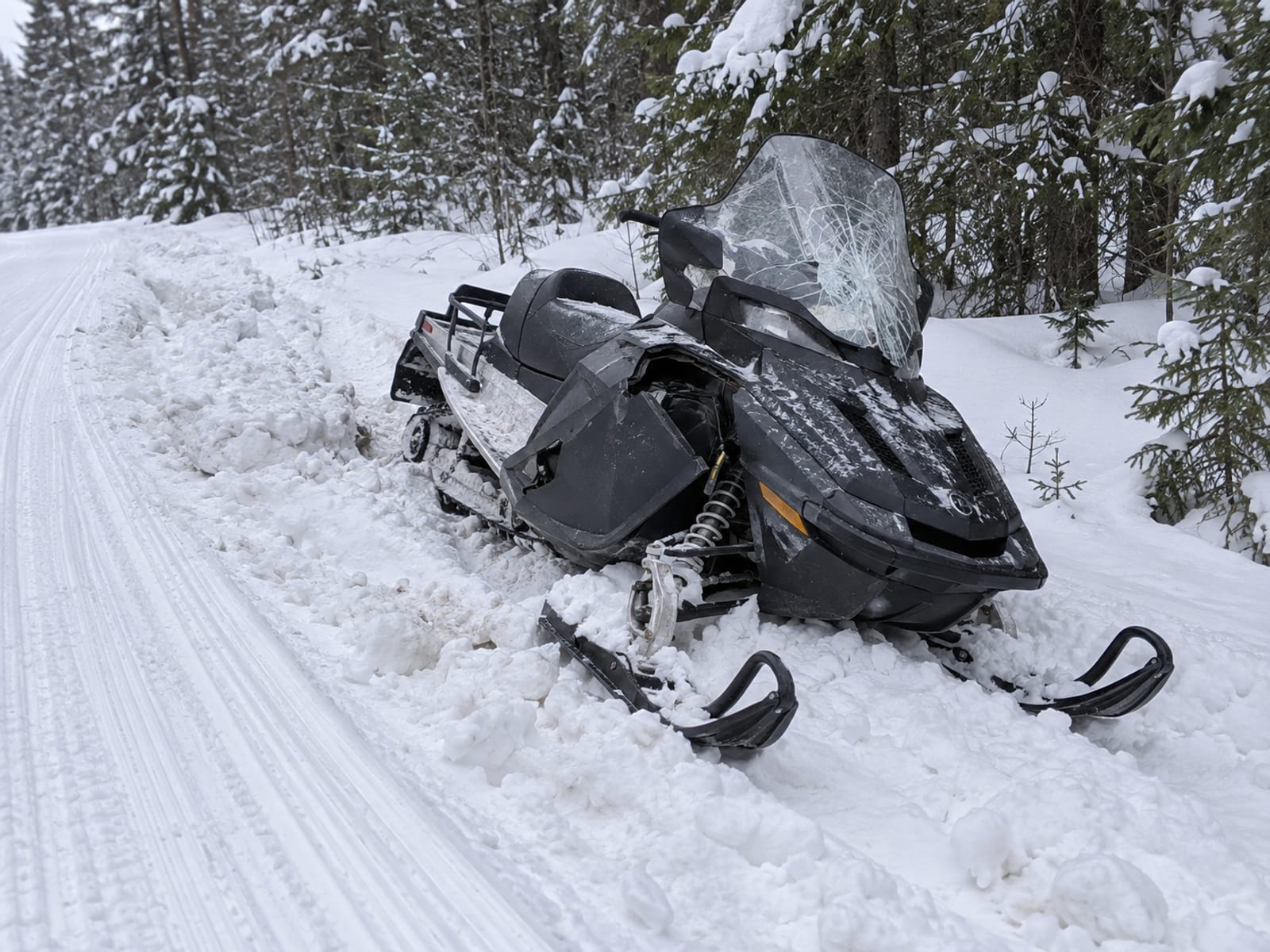
Injury or death. The operator must immediately report the accident by the quickest available means to the nearest law enforcement officer, under 12 M.R.S. § 13106-B (opens in a new tab). If the operator is unknown, an owner who knows about the crash must report it. The operator must give identifying and registration information to the injured person and other involved riders, and give reasonable assistance. Failing to comply is generally a Class E crime, and an intentional, knowing or reckless failure when the crash causes serious bodily injury or death is a Class C crime.
Property damage of $1,000 or more. When no one needed a physician's treatment and no one died, but estimated property damage reaches $1,000, the crash must be reported to the commissioner within 72 hours on the commissioner's forms, under 12 M.R.S. § 13106-C (opens in a new tab). Violations carry a civil fine of $100 to $500, with more serious consequences for repeat violations.
Any property damage. You must take reasonable steps to notify the property owner and, if asked, provide your name, address and registration number, under 12 M.R.S. § 13106-D (opens in a new tab). A violation is a Class E crime.
Hover or tap a row to highlight it.
| Situation | What you must do | Deadline or penalty | Source |
|---|---|---|---|
| Injury or death | Report immediately to the nearest law enforcement officer by the quickest available means | Generally a Class E crime; Class C when an intentional, knowing or reckless failure involves serious bodily injury or death | 12 M.R.S. § 13106-B (opens in a new tab) |
| Property damage of $1,000 or more, no physician treatment or death | Report to the commissioner on the commissioner's forms | Within 72 hours; civil fine of $100 to $500 | 12 M.R.S. § 13106-C (opens in a new tab) |
| Any property damage | Take reasonable steps to notify the property owner and give your name, address and registration number if asked | Class E crime | 12 M.R.S. § 13106-D (opens in a new tab) |
Landowner liability
Maine's recreational-use statute, 14 M.R.S. § 159-A (opens in a new tab), protects landowners, lessees, managers, easement holders and occupants from many duties and liabilities connected with recreational use, including snow-traveling vehicles. Giving permission generally does not promise the land is safe or make the owner responsible for injury or damage caused by riders. Exceptions include willful or malicious failure to warn of a dangerous condition and certain paid or exclusive recreational-use arrangements.
Young riders and who pays for their damage
Several age rules apply under 12 M.R.S. § 13106-A (opens in a new tab):
- A rider under 14 may not operate a snowmobile across a public way maintained for travel.
- No one may let a child under 10 operate a snowmobile unless an adult accompanies them, except on land owned by the parent or guardian or land where the parent or guardian has permission.
- Violations of these rules can bring a civil fine of $100 to $500, with more serious consequences for repeat violations.
Riders and passengers under 18 must wear protective headgear meeting specified standards, according to Maine IF&W safety information (opens in a new tab). Snowmobile safety certification is encouraged but not legally required, and students under 16 attending a course must come with a parent or guardian, according to the IF&W snowmobile safety page (opens in a new tab).
Liability for a minor's riding reaches the adults involved. The snowmobile owner, the person who furnished the sled and the parent or guardian responsible for the minor are jointly and severally liable with a rider under 18 for damage the minor causes, under 12 M.R.S. § 13108 (opens in a new tab). If young riders use your sled, ask your agent whether they are listed or permitted operators on your policy.
Questions to ask an insurance agency
- Will the snowmobile be insured under its own policy, a scheduled endorsement or another form?
- Does liability cover bodily injury and property damage caused while riding?
- Are all the people who will ride listed or permitted, including teenagers?
- Are passengers covered?
- Does coverage apply on private land, Maine trails, public ways, frozen water and out of state, including Canada?
- Are collision, comprehensive, theft, vandalism, fire, animal contact, ice breakthrough and weather losses covered?
- Are accessories, custom equipment, helmets, clothing and the trailer covered?
- Is medical payments or uninsured rider coverage available?
- Are racing, stunts, commercial use, rental use or lending the sled excluded?
- What deductible and valuation method apply, and what happens if the policy lapses in the off-season?
- What documents do you need, such as the registration, serial number, purchase information or lender details?
Check what you know about Maine snowmobile insurance
How to Choose an Insurance Agent walks through licensing checks and questions for any agency. If you want more liability protection on top of your sled policy, Do I Need Umbrella Insurance covers how excess liability works, and Inland Marine Insurance explains coverage for movable property.
Snowmobile insurance in Maine: quick answers
Does a Maine snowmobile registration include any liability coverage? No. Registration authorizes operation under 12 M.R.S. § 13104 (opens in a new tab) and funds trails, but it is not an insurance policy. Any liability, theft or damage protection has to come from a separate policy or endorsement.
Does liability insurance pay to fix my own sled? No. Liability covers injuries and property damage you cause to others. Collision addresses impact and overturning, and comprehensive addresses losses like theft, fire and vandalism, when those coverages are on your policy.
Can I ride on a neighbor's land if my sled is registered? Registration does not give you permission to enter anyone's land, under 12 M.R.S. § 13106-A (opens in a new tab). Get the landowner's permission first, and stop and identify yourself if the owner asks.
Who files the report if I cannot tell who was driving? For a crash involving injury or death, an owner who knows about it must report it when the operator is unknown, under 12 M.R.S. § 13106-B (opens in a new tab).
Before the first ride of the season
Register the sled through the right channel, get permission for any private land you plan to cross, and ask the club, trail, lender or rental company about its own rules. Then pull your homeowners and auto policies and read the motorized-vehicle exclusions. With those answers, a conversation with an agency about liability, physical damage and who rides your sled will be quick and specific.
Terms used in this guide
Tap a term to see what it means.
Registration. The legal right to operate a snowmobile in Maine, paid for with fees that fund trails; it is not an insurance policy.
Liability coverage. Pays for covered bodily injury and property damage to others that you are legally responsible for.
Collision. Covers damage to your sled from hitting another object or vehicle, and from overturning.
Comprehensive. Covers non-collision losses such as theft, fire, vandalism, weather, falling objects and animal contact.
Scheduled endorsement. An addition to a homeowners policy that lists a specific item, such as a snowmobile described by year, make, model and serial number.
Jointly and severally liable. Each responsible person can be held liable for the full amount of the damage.
Recreational-use statute. Maine law that protects landowners from many duties and liabilities when they allow recreational use of their land.