Does Vermont Require Motorcycle Insurance? Requirements, Coverage Options and What to Ask Your Agent
Riskado
Yes. Vermont requires liability insurance, or another accepted form of financial responsibility, before a registered motor vehicle, including a motorcycle, is ridden on the state's highways, under 23 V.S.A. § 800 (opens in a new tab). The minimum limits are $25,000 for bodily injury or death of one person, $50,000 for bodily injury or death of two or more people in one crash, and $10,000 for property damage in one crash. You must carry proof while riding, and proof on your phone counts. Your insurance is a separate requirement from your motorcycle endorsement or learner permit. Collision, comprehensive, medical payments and coverage for accessories are separate choices, and a lender can require more than the legal minimum. These rules were checked October 1, 2026.
Key takeaways
- Is it required?Yes. Liability insurance, or another accepted form of financial responsibility, is required before a registered motorcycle is ridden on Vermont highways.
- Minimum limits$25,000 for one person, $50,000 for two or more people in one crash and $10,000 for property damage.
- ProofYou must carry proof while riding, and proof on your phone counts.
- LicensingYour insurance is a separate requirement from your motorcycle endorsement or learner permit.
- Optional coveragesCollision, comprehensive, medical payments and accessory coverage are separate choices, and a lender can require more.
Vermont's Minimum Motorcycle Liability Limits
Vermont does not set a separate minimum for motorcycles. The limits in 23 V.S.A. § 800 (opens in a new tab) apply to motor vehicles required to be registered, which includes your bike:
- $25,000 for bodily injury or death of one person in one crash.
- $50,000 for bodily injury or death of two or more people in one crash.
- $10,000 for damage to other people's property in one crash.
These limits pay others when you are at fault. Say you hit a car at an intersection and injure its driver: your liability coverage pays up to $25,000 toward that person's injuries and up to $10,000 toward the damage to their car. Your own injuries and damage to your motorcycle come from other coverages.
The same section allows a bond or approved self-insurance instead of a policy. If you want to use a method other than a policy, ask the Vermont DMV (opens in a new tab) what documentation it accepts.
Hover or tap a row to highlight it.
| Requirement or rule | Value | Source |
|---|---|---|
| Bodily injury, one person | $25,000 | 23 V.S.A. § 800 (opens in a new tab) |
| Bodily injury, two or more people | $50,000 per crash | 23 V.S.A. § 800 (opens in a new tab) |
| Property damage | $10,000 per crash | 23 V.S.A. § 800 (opens in a new tab) |
| Civil penalty for riding without required coverage | Up to $500 | 23 V.S.A. § 800 (opens in a new tab) |
| Civil penalty for failing to carry proof | Up to $100 | 23 V.S.A. § 800 (opens in a new tab) |
| Time to produce proof that was active at the stop | Seven business days | 23 V.S.A. § 800 (opens in a new tab) |
| Time to provide proof after DMV notice | 20 days | 23 V.S.A. § 802 (opens in a new tab) |
| Financial responsibility filing period | At least three years | Vermont DMV |
What Proof of Insurance You Must Carry
You need proof of financial responsibility with you whenever you ride on Vermont highways. Under 23 V.S.A. § 800(c) (opens in a new tab), you can show it on a portable electronic device, which helps on a bike with little storage space.
If you are stopped and cannot show proof, but your coverage was active at the time, you will not be convicted of that violation if you send or bring proof to the agency that issued the ticket within seven business days, according to § 800 (opens in a new tab). Not carrying proof carries a civil penalty of up to $100. 23 V.S.A. § 804 (opens in a new tab) sets the methods of proof and the rules for insurer filings.
How Insurance Ties to Registration and Inspection
You certify your insurance when you register. The Vermont registration application, form VD-119 (opens in a new tab), requires you to certify that the liability insurance required by § 800 is in effect.
Inspection needs proof too. You must present an insurance identification card at the inspection station, according to the DMV registration page (opens in a new tab). Have your policy in place before you head to either step.
What Happens If You Ride Without Insurance
Riding without the required coverage is a traffic violation with a civil penalty of up to $500, under 23 V.S.A. § 800(b) (opens in a new tab). An uninsured-operation citation can also bring points and a requirement to file Financial Responsibility Insurance and keep that filing for at least three years, according to the Vermont DMV (opens in a new tab). That filing is made through an SR-22, a certificate your insurance company files with the DMV.
License consequences follow if you do not respond. When the DMV requires proof of financial responsibility under § 801 (opens in a new tab) and you do not provide it within 20 days after the notice is mailed, § 802 (opens in a new tab) requires suspension of your license or operating privilege until you furnish proof. If you receive a DMV notice, contact your insurer right away so the filing goes in on time.
Your Endorsement and Your Insurance Are Separate Requirements
Licensing and insurance answer different questions. The endorsement shows you are qualified to ride; insurance shows you can pay for harm you cause.
If you are a Vermont resident riding on a Vermont highway, you need a motorcycle endorsement, according to the Vermont DMV motorcycle endorsement page (opens in a new tab). Getting it takes a knowledge exam and a skills exam, unless you complete an approved course through the Vermont Rider Education Program (opens in a new tab) that waives those tests. The motorcycle you bring to a skills exam must be registered, inspected when required, insured and in good mechanical condition.
Learner permit holders carry insurance obligations too. You must carry an insurance card while riding on a permit, according to the DMV learner permit page (opens in a new tab).
Uninsured and Underinsured Motorist Coverage
Vermont builds this protection into qualifying policies. Under 23 V.S.A. § 941 (opens in a new tab), motor vehicle liability policies for vehicles registered or principally garaged in Vermont must include protection for insured people who are legally entitled to recover from an uninsured, underinsured or hit-and-run driver.
For new or renewed policies, the bodily-injury limits are at least $50,000 per person and $100,000 per crash. If your liability limits are higher, your uninsured motorist limits are generally the same unless you direct otherwise. The statute also covers property damage up to $10,000 per claim with a $150 deductible, subject to its exceptions. For a rider, this is the coverage that responds when a driver without enough insurance causes the crash.
Ask your agent what UM and UIM limits your motorcycle policy carries and how its deductibles work.
Optional Coverages for Your Motorcycle
Everything beyond liability and UM/UIM is a choice, unless a lender requires it. Common coverages, as described by the NAIC consumer auto guide (opens in a new tab) and the NAIC's explanation of what auto insurance covers (opens in a new tab):
- Collision pays for damage to your motorcycle from hitting another vehicle or object.
- Comprehensive pays for damage from causes other than a collision, such as theft, fire, weather, vandalism or hitting an animal.
- Medical payments can pay medical expenses for you and your passengers, subject to policy terms.
Motorcycle policies can also include these coverages, according to Progressive's Vermont motorcycle insurance page (opens in a new tab):
- Accessories and custom equipment. Custom parts, electronics, paint, chrome, luggage and riding gear may be listed separately or capped, so ask how your policy treats each one.
- Towing or roadside assistance for specified services.
- Rental or transport-related coverage, depending on the policy.
Coverage names, limits, exclusions, deductibles and valuation all vary by policy, so compare the actual policy wording rather than the labels.
Financing or Leasing a Motorcycle
A lender or leasing company can require comprehensive and collision coverage even though Vermont law does not, according to the NAIC (opens in a new tab). Read your loan or lease contract for required coverages, deductibles and how the lender must be listed, and ask the lender if anything is unclear.
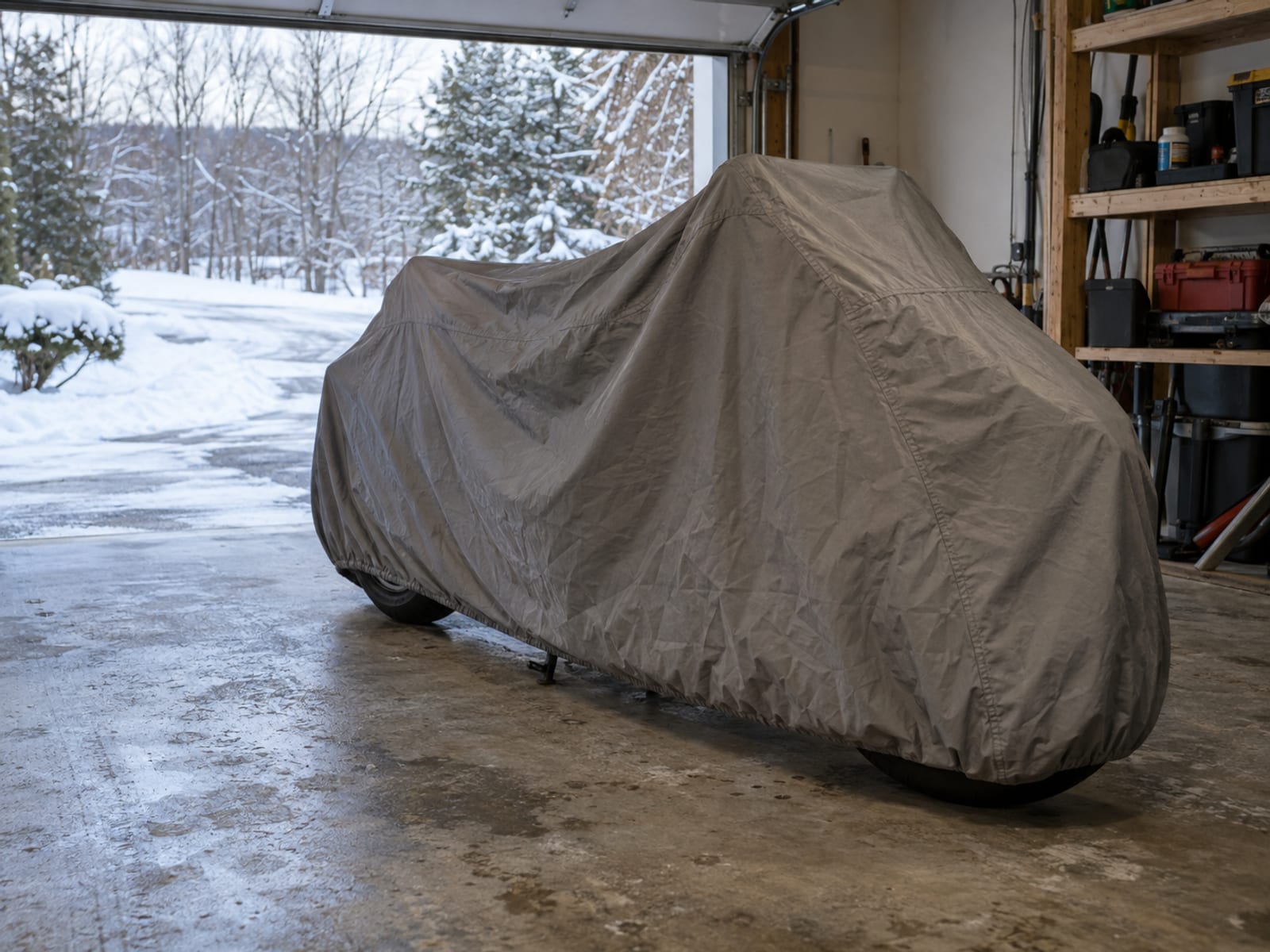
Can You Change Coverage During Winter Storage?
Vermont's financial responsibility rule applies when the motorcycle is operated on the highway, under 23 V.S.A. § 800 (opens in a new tab). Before canceling, suspending or reducing your policy for winter, ask your insurer how the change would affect protection against theft, fire, weather and vandalism while the bike is stored, and how it affects your liability coverage and any lender requirement. Then confirm with the Vermont DMV (opens in a new tab) whether the change affects your registration or any financial responsibility filing.
Personal Versus Business Use
A personal motorcycle policy is written for personal riding. If you use your bike for commuting, touring, deliveries, rentals, instruction or any other business purpose, ask your agent whether the policy covers that use and whether passenger coverage applies.
What Vermont Motorcycle Insurance Costs
Prices depend on the rider and the bike. Cost varies with factors including your age, riding history, location, motorcycle type and the coverage you choose, according to Progressive (opens in a new tab). For a reliable number, ask an agency for a quote with the exact limits, deductibles and optional coverages you want, and request the same setup from each agency you compare.
Questions to Ask an Insurance Agency
Bring these questions, based on NAIC guidance (opens in a new tab) and Vermont's requirements:
- Does the policy meet Vermont's $25,000/$50,000/$10,000 liability minimums?
- What proof of insurance will I get, and can I show it on my phone?
- Will the policy work for registration, inspection and a motorcycle skills exam?
- What are my UM and UIM limits and deductibles?
- How are collision and comprehensive claims valued?
- Are custom parts, accessories, electronics, luggage, helmets and riding gear covered?
- Is medical payments coverage available for me and my passenger?
- Is towing or roadside assistance included?
- What does the policy cover while the motorcycle is stored, and what happens if coverage lapses?
- Does it cover commuting, touring, delivery or other business use?
- What does my lender or lessor require?
- Which exclusions, deductibles and use restrictions apply?
- What documents do you need to issue coverage?
Riskado's directory lists insurance agencies by city and category in Vermont, if you would like to compare agencies.
Check what you know about Vermont motorcycle insurance
Vermont Motorcycle Insurance FAQ
Do I need insurance to ride on a Vermont learner permit?
Yes. You must carry an insurance card while riding on a learner permit, according to the Vermont DMV (opens in a new tab). The motorcycle you use for the skills exam must also be insured.
Is an SR-22 required for every Vermont rider?
No. An SR-22 filing comes into play after events such as an uninsured-operation citation, and the DMV then requires you to maintain the filing for at least three years, according to the Vermont DMV (opens in a new tab).
What happens if the DMV asks me for proof of financial responsibility?
You have 20 days after the notice is mailed to provide it. If you do not, 23 V.S.A. § 802 (opens in a new tab) requires suspension of your license or operating privilege until you furnish proof.
Does Vermont require collision coverage on a motorcycle?
State law does not, according to the NAIC (opens in a new tab). A lender or lessor can require it under your financing contract.
Before You Ride
Make sure your policy carries at least 25/50/10 liability and the UM/UIM coverage Vermont builds in, keep proof on paper or your phone, and keep your endorsement or permit current as its own requirement. Then decide on collision, comprehensive, medical payments and accessory coverage with an agent who can show you the policy wording.
Terms used in this guide
Tap a term to see what it means.
Financial responsibility. Vermont's requirement that a registered vehicle ridden or driven on its highways be backed by a liability policy, a bond or approved self-insurance.
Motorcycle endorsement. The license credential that shows a Vermont resident is qualified to ride a motorcycle.
Learner permit. A permit for riding while learning, which still requires carrying an insurance card.
UM/UIM coverage. Uninsured and underinsured motorist coverage, which protects insured people hurt by an uninsured, underinsured or hit-and-run driver.
SR-22. A certificate your insurance company files with the DMV to show Financial Responsibility Insurance is in place.
Accessories and custom equipment. Custom parts, electronics, paint, chrome, luggage and riding gear, which a policy may list separately or cap.