Georgia Renters Insurance: What It Costs, What Landlords Can Require, What It Covers and Student Options Near Georgia Tech and Georgia Southern
Riskado
Renters insurance in Georgia is usually a lease requirement, not a state law requirement: some landlords require tenants to carry it, according to the Georgia Office of Commissioner of Insurance and Safety Fire (opens in a new tab). A renters policy, the HO-4 form, generally covers your belongings, your personal liability, medical payments to others and extra living costs after a covered loss. Your landlord's insurance protects the building, not your things. Standard policies generally don't cover flood, and your policy's limits, deductible and exclusions control any claim. In 2023, Georgia's average HO-4 premium was $206 a year, according to the NAIC's Homeowners Report (opens in a new tab). If you're a student, confirm whether a parent's policy reaches your housing before you rely on it.
Key takeaways
- Who requires itYour lease, when the landlord makes it a condition. Some Georgia landlords do.
- What it coversYour belongings, personal liability, medical payments to others and additional living expenses after a covered loss.
- What it leaves outThe building itself, flood and earthquake damage, and anything outside the policy's covered perils.
- Average cost$206 a year for a Georgia HO-4 policy in 2023, a statewide average and not a quote.
- StudentsGeorgia Tech and Georgia Southern don't insure resident belongings and tell students to buy a policy or confirm family coverage.
Is renters insurance required in Georgia?
For most tenants, the answer is in the lease. Georgia's landlord-tenant law, Title 44, Chapter 7 of the Official Code of Georgia (opens in a new tab), covers repairs, security deposits, dispossessory proceedings and other lease matters. A renters insurance requirement, when you have one, comes from the lease you sign, and OCI notes that some landlords require it (OCI, 2023 (opens in a new tab)).
Before you sign, find the insurance clause and check for:
- The type of coverage required.
- A required liability limit.
- A deadline for showing proof of insurance.
- Whether the landlord must be listed to receive notice if the policy is canceled.
- What happens if your coverage lapses during the lease.
Ask the landlord or property manager to put any requirement in writing if the lease is vague. Then ask your agency for proof of insurance that matches the clause.
What does renters insurance cost in Georgia?
Georgia's average premium for a tenant policy was $206 in 2023, according to the NAIC's Homeowners Report (opens in a new tab). The same table puts the average condo-unit policy at $748. These are statewide averages across all coverage amounts, not a quote for your apartment.
Hover or tap a row to highlight it.
| Policy form | Average annual premium | Source |
|---|---|---|
| HO-4, tenants | $206 | NAIC Homeowners Report, 2023 data |
| HO-6, condominium and co-op units | $748 | NAIC Homeowners Report, 2023 data |
| HO-4 and HO-6 combined | $284 | NAIC Homeowners Report, 2023 data |
Your own price depends on how much personal property coverage you choose, your deductible, your liability limit, where you live and the insurer's underwriting. OCI's August 2023 student release cited an Insurance Information Institute estimate of $212 a year, or just over $17 a month, for Georgia renters (OCI (opens in a new tab)).
What does renters insurance cover?
A renters policy has four main parts, and each one answers a different problem.
Personal property. This pays to repair or replace your belongings if they're damaged, destroyed or stolen by a covered cause, according to the NAIC (opens in a new tab). OCI's 2023 release notes that most policies cover phones, computers, televisions, furniture and clothing (OCI (opens in a new tab)). Theft has its own questions, which our article on whether renters insurance covers theft answers.
Personal liability. This responds to covered claims that you injured someone or damaged their property. A guest who trips and is hurt in your apartment is the usual example.
Medical payments to others. This can pay limited medical bills for certain injuries to visitors, without the same fault determination that liability coverage needs.
Additional living expenses. If a covered loss makes your home unlivable, this can pay for a hotel, meals and other extra costs while repairs are made. OCI lists additional living expenses, personal liability and medical payments among the standard parts of a package policy (OCI (opens in a new tab)).
Our national article on what renters insurance covers goes further into each part.

What does renters insurance not cover?
Flood. Most policies don't cover floods or earthquakes, and those can usually be bought as separate policies, according to OCI (opens in a new tab). If you rent, your landlord's flood policy won't cover your personal property, and a flood policy usually has a 30-day waiting period before coverage begins, according to the NAIC (opens in a new tab). Our article on Georgia flood insurance covers contents-only flood policies.
The building. Walls, floors, built-in appliances and the roof belong to the landlord's coverage.
High-value items above special limits. Jewelry, art and other expensive possessions may need extra coverage, according to the NAIC (opens in a new tab). Ask whether an item has to be scheduled or appraised.
Your roommate's things. Another person's belongings aren't covered unless the policy includes them.
Losses outside the covered perils. The policy lists what causes of loss it covers. Your deductible comes out first, and the policy limit caps the payment.
Does the landlord's insurance cover you?
No, not for your belongings. Landlords may carry coverage that protects the property, but those policies almost never cover a tenant's belongings, according to OCI (opens in a new tab). The NAIC (opens in a new tab) puts it the same way: the landlord's policy doesn't cover the things you own.
A landlord's policy also doesn't give you personal liability protection. If you damage the unit or a neighbor's property, or a guest is hurt, your own policy and your lease decide who pays.
How does liability coverage work?
Liability coverage applies to claims or lawsuits over bodily injury or property damage you cause to others, and every renters policy has a liability limit, which is the most it pays, according to the NAIC (opens in a new tab). The limit appears on your declarations page and varies by policy.
Accidental damage to the apartment is a separate question from a guest's injury. Georgia Southern warns that students can be held liable for damage they cause by accident or negligence, such as a fire from something left on the stove, and that many renters policies don't automatically cover that kind of loss (Georgia Southern (opens in a new tab)). Ask your agency:
- What liability limit is included?
- Does it apply to accidental damage to the rental unit?
- Are defense costs inside or outside the limit?
- Are pets, roommates, short-term rentals or business activities excluded?
- What medical payments limit applies?
Actual cash value or replacement cost: how are belongings valued?
An actual cash value policy pays for contents at cost minus depreciation, while replacement cost coverage replaces them at today's prices, according to OCI (opens in a new tab). The difference shows up most with older electronics and furniture, where depreciation can take a large share of the original price.
Replacement cost still works inside the policy's limits, deductible and settlement conditions. Some policies pay the depreciated value first and the rest after you repair or replace the item, so ask how your insurer settles a replacement cost claim. Our article on replacement cost vs actual cash value shows how the two settle the same loss.
Can a college student use a parent's policy?
Sometimes, and it's worth confirming before move-in day. A parent's homeowners policy may cover a student's belongings at school, but the answer depends on how the policy defines an insured person, the type of housing and the limit for property away from home.
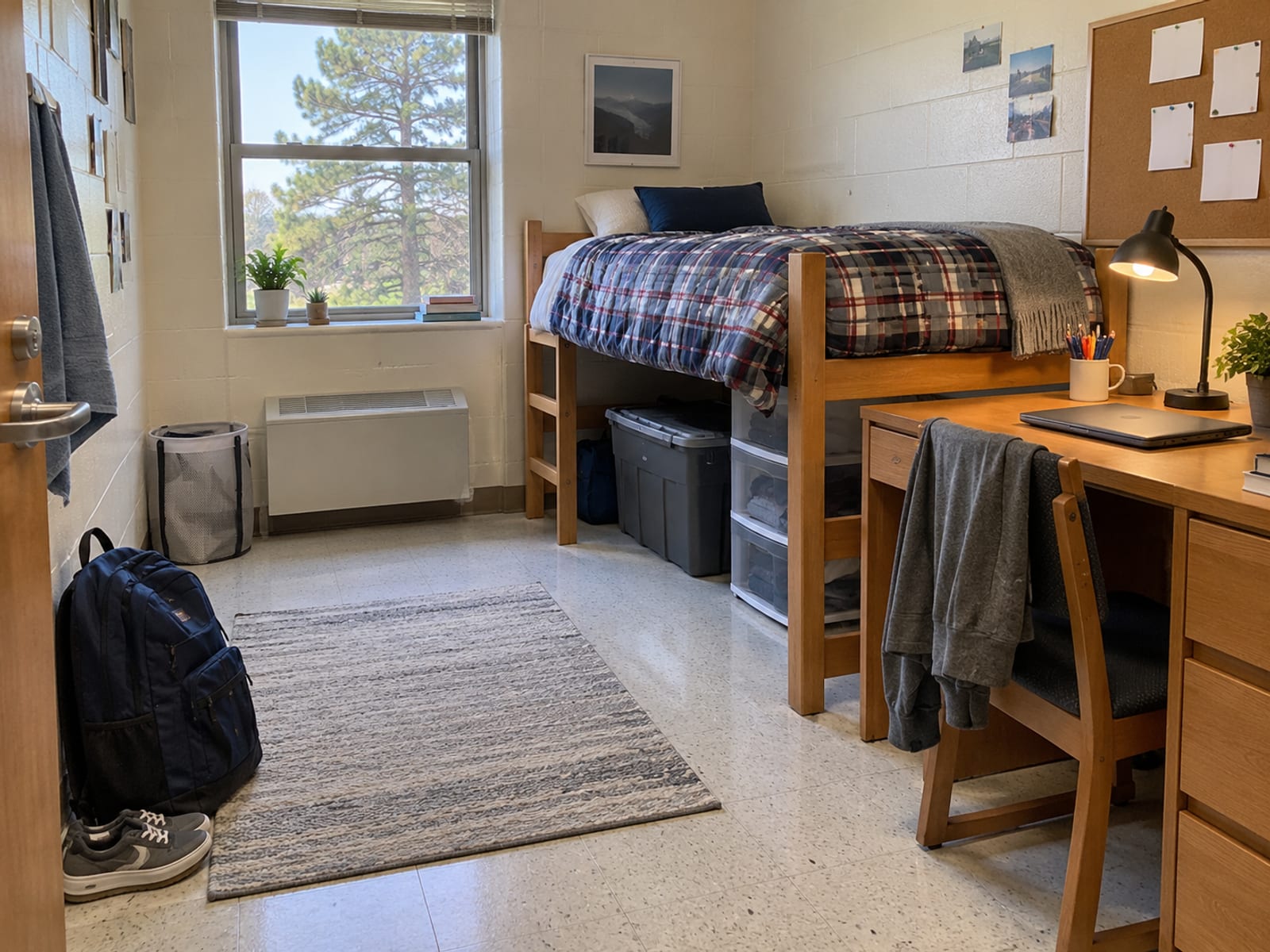
Georgia Tech. Georgia Tech and its staff aren't responsible for the loss, damage or destruction of a resident's personal property. Residents are strongly encouraged to buy rental insurance or confirm that a family homeowners policy covers these losses, and getting that coverage is the resident's responsibility (Georgia Tech Housing (opens in a new tab)).
Georgia Southern. University Housing doesn't insure residents' belongings for damage or theft. Students should check whether a parent's homeowners policy covers them at school, and some policies also cover items outside the room, such as laptops, and may continue if the student moves off campus. The university also strongly advises coverage for damage to a room or campus facilities (Georgia Southern (opens in a new tab)).
Georgia State. Students registering for housing can choose to buy a renters policy through the university's housing program. It's optional, and the policy's own terms control coverage (Georgia State Housing (opens in a new tab)).
Off-campus apartments are where a lease requirement is most likely. Ask the parent's insurer whether the student is still an insured person at an off-campus address, and get the answer in writing.
What should roommates know?
One roommate's policy doesn't automatically cover another roommate. Who counts as an insured depends on the policy's definitions, who is named on it and any endorsements. Before you share a policy or rely on a roommate's, ask:
- Which people are named insureds?
- Are unrelated roommates covered?
- Are each person's belongings included?
- How is the personal property limit shared?
- Does one roommate's claim affect the others?
- Does the lease require each tenant to show separate proof?
How do you document and file a claim?
Start the inventory before you need it. Make a list of jewelry and other expensive items, furniture and electronics, photograph or video your possessions, and keep copies somewhere outside your home, as OCI (opens in a new tab) advises.
After a loss, file as soon as possible and check whether your policy sets a reporting deadline, according to OCI's claim tips (opens in a new tab). Keep copies of all correspondence and a log of calls with dates, names and what was discussed. Save receipts for temporary repairs. For a theft, file a police report and keep the report number. If a claim is denied, ask for a written letter that explains the reason and cites the policy language.
Filing a Georgia renters claim
- Right awayNotify your agent or insurer and check the policy's reporting deadline.
- When it's safePrevent further damage and keep receipts for temporary repairs.
- Same day if possiblePhotograph the damage and file a police report for a theft.
- Within the policy's deadlineSend your inventory, receipts and any proof-of-loss form the insurer requires.
- ThroughoutKeep copies of everything and log each call.
- If deniedAsk for a written explanation that cites the policy language.
What happens if the policy is canceled or nonrenewed?
Georgia's notice rules for property policies changed on January 1, 2026. O.C.G.A. § 33-24-46 (opens in a new tab) applies to policies insuring a person against direct loss to residential real property and its contents. For policies the section covers:
- An insurer must mail or deliver a written nonrenewal notice at least 60 days before the nonrenewal takes effect, or longer if the contract or another statute allows. Before January 1, 2026, the section used 30 days.
- After a policy has been in effect more than 60 days, or after a renewal takes effect, the insurer can cancel only for nonpayment of premium, fraud or material misrepresentation, a change in risk that substantially increases a covered hazard, or a violation of a material policy term.
- A reduction in coverage needs a separate written notice at least 30 days before it takes effect, headed "NOTICE OF REDUCTION IN COVERAGE."
- A cancellation for a reason other than nonpayment, or a nonrenewal, must include notice of possible eligibility for the Georgia FAIR Plan, which our article on the Georgia FAIR Plan explains.
Ask your insurer whether your renters policy falls under the section. Whatever the answer, a lapse leaves your belongings and liability unprotected and may break your lease, so line up a replacement policy before the old one ends.
How do you check an agent or file a complaint?
Agents, agencies and insurance companies must be licensed to do business in Georgia, according to OCI's licensing page (opens in a new tab). Use the Georgia insurance license lookup (opens in a new tab) before you share personal documents.
For a dispute, contact the insurer or agent first and keep records of every call and email. If the problem isn't resolved, file once through OCI's online Consumer Complaint Portal with the insurer's name, the agent or adjuster's name, the policy and claim numbers, the loss date, a short description and copies of your documents, according to OCI's complaint page (opens in a new tab).
Questions to ask an agency
- What property and causes of loss are covered?
- Does the policy pay actual cash value or replacement cost?
- What deductible applies?
- What liability and medical payments limits apply?
- Does the policy include additional living expenses?
- What exclusions apply to water, flood, earthquake, mold, pets or business activity?
- Do jewelry, electronics, bicycles or other expensive items have special limits, and do they need scheduling?
- Are my belongings covered away from the apartment?
- Is a student covered in a dorm or an off-campus apartment?
- Are roommates covered?
- What is the deadline for reporting a claim?
- What proof of insurance can you send my landlord?
If you're comparing policies, Riskado's directory lists insurance agencies across Georgia by city and by category.
Check what you know about Georgia renters insurance
Frequently asked questions
Can my landlord require renters insurance in Georgia?
Yes, a landlord can make it a condition of the lease, and some Georgia landlords do, according to OCI (opens in a new tab). Read the insurance clause for the required coverage, any liability limit and the deadline for proof.
How much renters insurance is usual for liability?
There's no single usual amount. Every policy has a liability limit, the most it will pay, and it's listed on the declarations page, according to the NAIC (opens in a new tab). If your lease sets a minimum, buy at least that much.
Does renters insurance pay for a hotel after a fire?
It can. Additional living expenses coverage pays extra costs such as a hotel and meals when a covered loss makes your home unlivable, subject to the policy's limit. Keep every receipt.
Is the $206 average what I'll pay?
No. It's Georgia's 2023 statewide average for HO-4 policies across all coverage amounts, from the NAIC's Homeowners Report (opens in a new tab). Your premium depends on your coverage amount, deductible, liability limit, location and the insurer.
Do I need a separate policy if I already have one through my parents?
Maybe not. Georgia Tech and Georgia Southern both tell students to confirm whether a family homeowners policy covers them at school (Georgia Tech (opens in a new tab), Georgia Southern (opens in a new tab)). Ask the insurer how much property coverage applies away from home and whether an off-campus apartment counts.
Before you sign the lease
Read the insurance clause, confirm who is named on the policy and whether family coverage applies, and make an inventory with photos. Ask about actual cash value versus replacement cost, special limits, flood and liability. Save the declarations page, send proof to your landlord if the lease requires it and keep the policy active for the whole lease term.
Key terms
Tap a term to see what it means.
HO-4. The standard renters, or tenant, policy form, covering personal property and liability but not the building.
Personal property coverage. Coverage that repairs or replaces your belongings after a covered loss.
Personal liability coverage. Coverage for claims that you injured someone or damaged their property.
Medical payments to others. Coverage for limited medical bills of visitors hurt at your home, without a fault finding.
Additional living expenses. Extra costs such as a hotel and meals while a covered loss makes your home unlivable.
Actual cash value. A payment for property at its cost minus depreciation.
Replacement cost. A payment that replaces property at today's prices, subject to policy terms.
Declarations page. The page that lists your coverages, limits, deductible and policy dates.
Named insured. A person listed by name on the policy.